

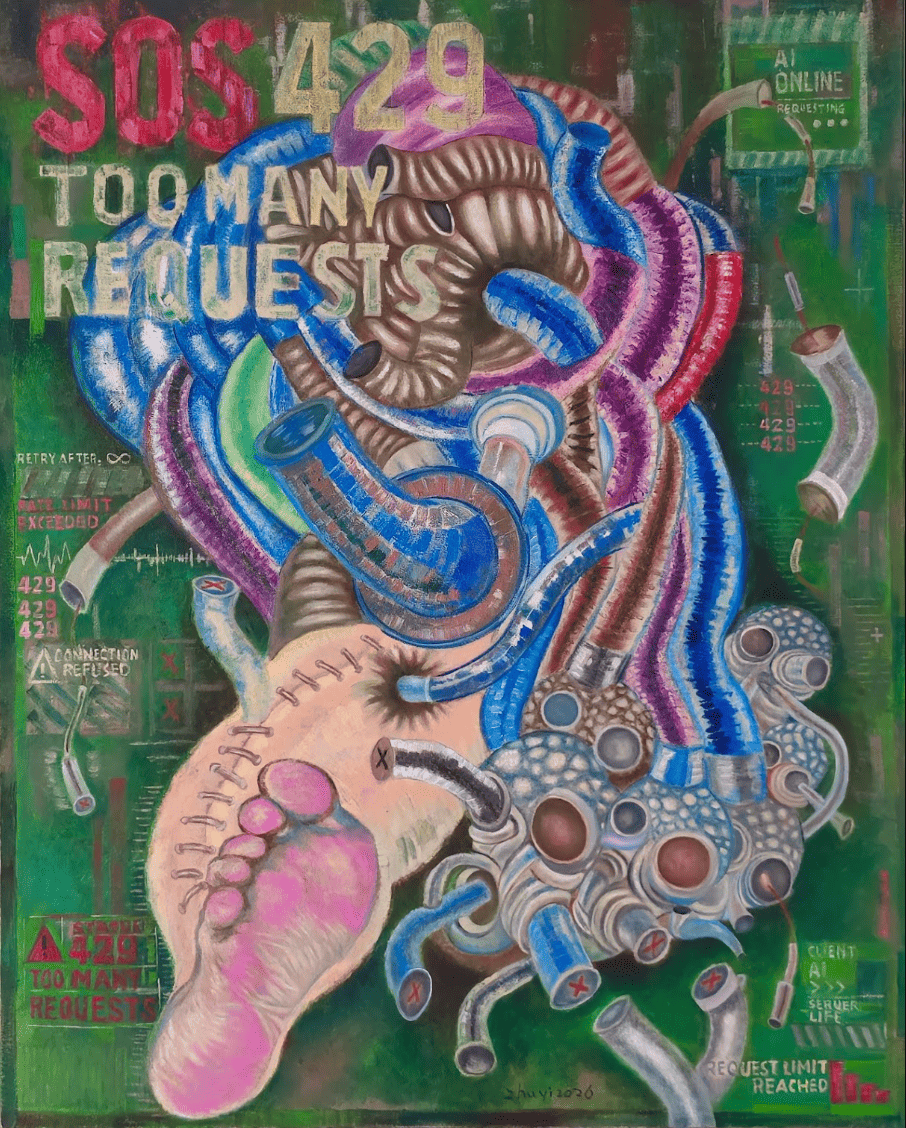
Before he was an artist known for canvases that speak in server codes, Yi Zhu spent years watching people compete for attention inside boardrooms, retail shelves, and advertising pitches. He ran a design company. He knew what it felt like to chase a client’s approval, to lose a pitch, to win an award and feel nothing shift underneath it. Long before “429 Too Many Requests” became the title of a painting, he had lived something close to its meaning, professionally, for years.
That history matters, because it explains why 201 → 429 → 503, the series that has become central to his current practice, doesn’t feel like a technologist’s gimmick. It feels like the record of someone who spent a career inside systems of pressure and finally found a way to paint what that pressure does to a body.
A Childhood Inside Change
Yi Zhu grew up during one of the most transformative stretches in modern Chinese history, a period when the economic ground itself seemed to shift beneath an entire generation. That environment appears to have taught him early that identity is not fixed, that a person is always being remade by forces larger than themselves. His first creative instincts went toward printmaking and illustration, disciplines that reward precision and structure, and the compositional intelligence from those years still shows in the architectural clarity of his current paintings.
From the Boardroom Back to the Studio
For a stretch of his career, painting took a back seat to business. Yi Zhu built and led his own design company, working across China’s advertising market, developing point-of-sale concepts and packaging for international consumer goods brands. The work was demanding and competitive, and it paid off: his team earned a Best Creative Award and a Best Supplier Award from the Chinese arm of a major global company. But success inside that world came with an education he hadn’t sought out. He watched colleagues and clients navigate ambition, exhaustion, and the strange human need to keep proving one’s relevance inside a system that never stops asking for more.
Those observations didn’t disappear when he stepped back from design. They became material. Yi Zhu has described his working method as one of deconstruction and reconstruction, taking apart the emotional residue of competition and business life and rebuilding it as image. Then, in 2019, the world gave him an unplanned and unwelcome laboratory for that method. As the pandemic isolated people worldwide, Yi Zhu found himself producing an unusually large body of oil paintings and prints, working through what he calls the fundamental logic of life: breathing. Exhalation as tension. Inhalation as contraction. And beneath both, a conviction that life should never be permanently suppressed, because its essence is freedom.
Where the Status Codes Came From
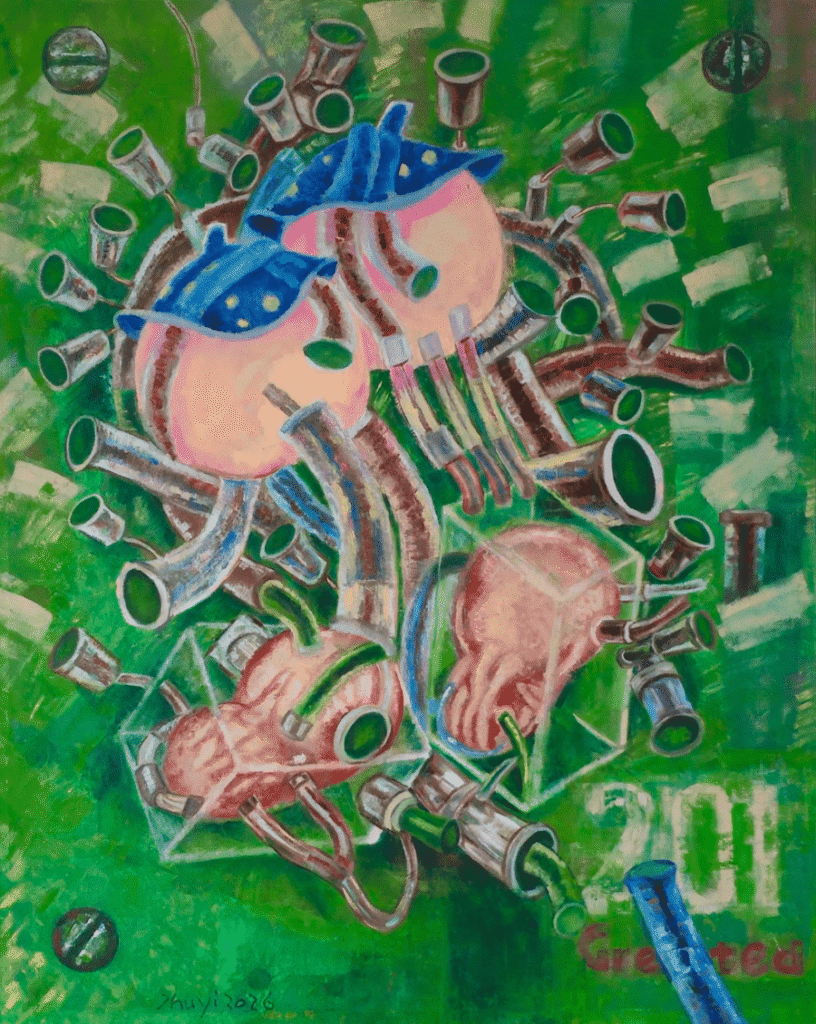
It was out of that period of reflection that 201 → 429 → 503 began to take shape. Anyone who has used the internet has quietly absorbed these three codes without noticing: 201 Created, the quiet confirmation that something new now exists; 429 Too Many Requests, the polite refusal a server issues when it’s asked for more than it can give; 503 Service Unavailable, the shutdown that follows when a system simply cannot keep up. Yi Zhu recognized in these three technical phrases a shape that matched his own understanding of a life lived under constant demand: you are created, you are asked for too much, and eventually you have to step back or break.
Bodies That Won’t Stay Still
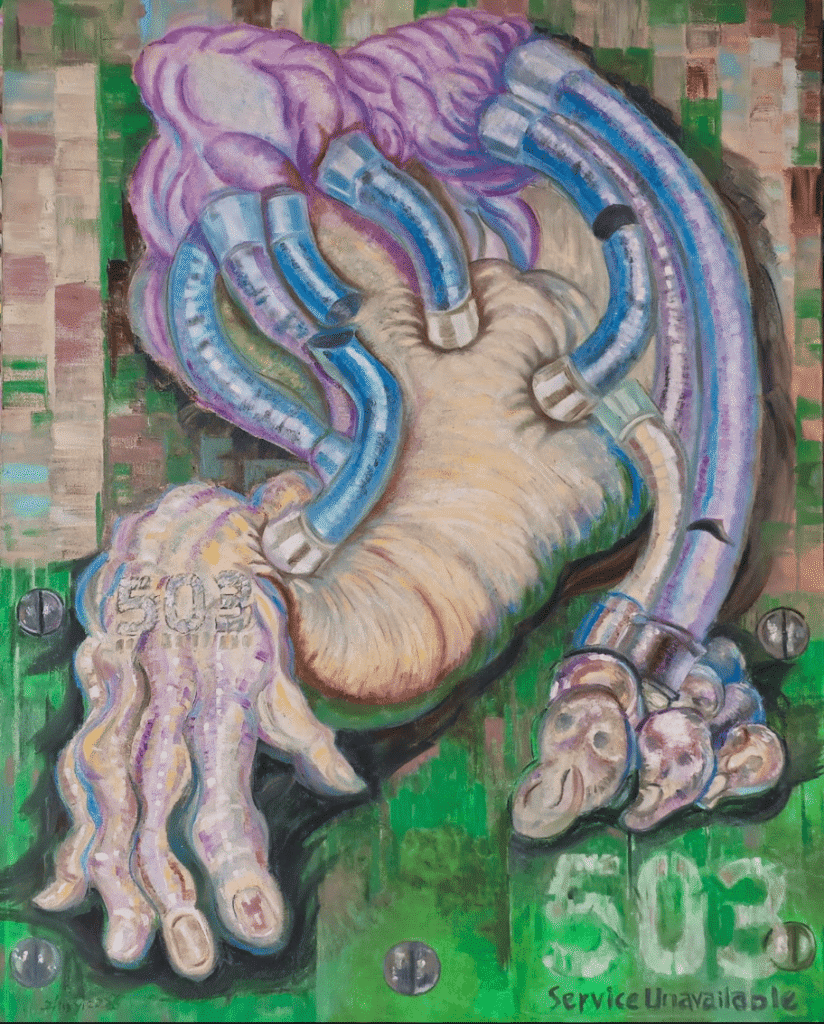
Walk through the paintings in sequence and the narrative becomes physical. In the 201 works, figures emerge tangled with pipelines and interface-like structures, as if the very systems that produced them are still deciding their shape. By 429, bodies swell and strain against their own outlines, connection tipping over into something closer to overload. By 503, the same bodies curl inward, pull away from the structures that once held them, searching for an exit that reads less like failure and more like self-defense. Soft, organic forms intertwine constantly with hard industrial geometry, and Yi Zhu never lets the viewer settle comfortably on one side of that boundary. The effect is less like looking at a diagram and more like watching a body remember what it feels like to be overwhelmed.
A Growing Presence, Built Slowly
The recognition has followed steadily rather than suddenly. Yi Zhu’s paintings have traveled to the Museu Europeu d’Art Modern in Barcelona, to art fairs in Innsbruck and Madrid, to Shanghai’s Art Plus and London’s Art Below, and to Venice for “THE BODY LANGUAGE 2025” with ITSLIQUID. In New York, he has shown repeatedly at ArtExpo and the Chelsea Biennale, winning Best Solo Exhibitor honors at ArtExpo in 2023. His painting “See the world” found a buyer at auction in 2025 through LiveAuctioneers via Chinwe Russell Art Gallery. Along the way he has collected the Luxembourg Art Prize’s Certificate of Artistic Achievement in three consecutive years, gold prizes from the Global Best Creative Awards and Future Art & Design Award UK, and, in the summer of 2026, a Platinum Prize in Painting & Fine Art from the UK International AI Award. This year also brought his solo exhibition “From Genesis to Presence” in Beijing, a title that reads almost like a summary of everything 201 → 429 → 503 has been building toward.
What makes Yi Zhu worth watching isn’t the novelty of painting server language onto canvas. It’s that he earned this language honestly, through years of watching people, including himself, strain under systems built to demand constant availability. His next body of work will likely keep circling the same question that has occupied him since he left the design world behind: not whether connection is good or bad, but how much of it a person can hold before they need, briefly and without apology, to disappear.
Follow @zhuyi515 on Instagram