

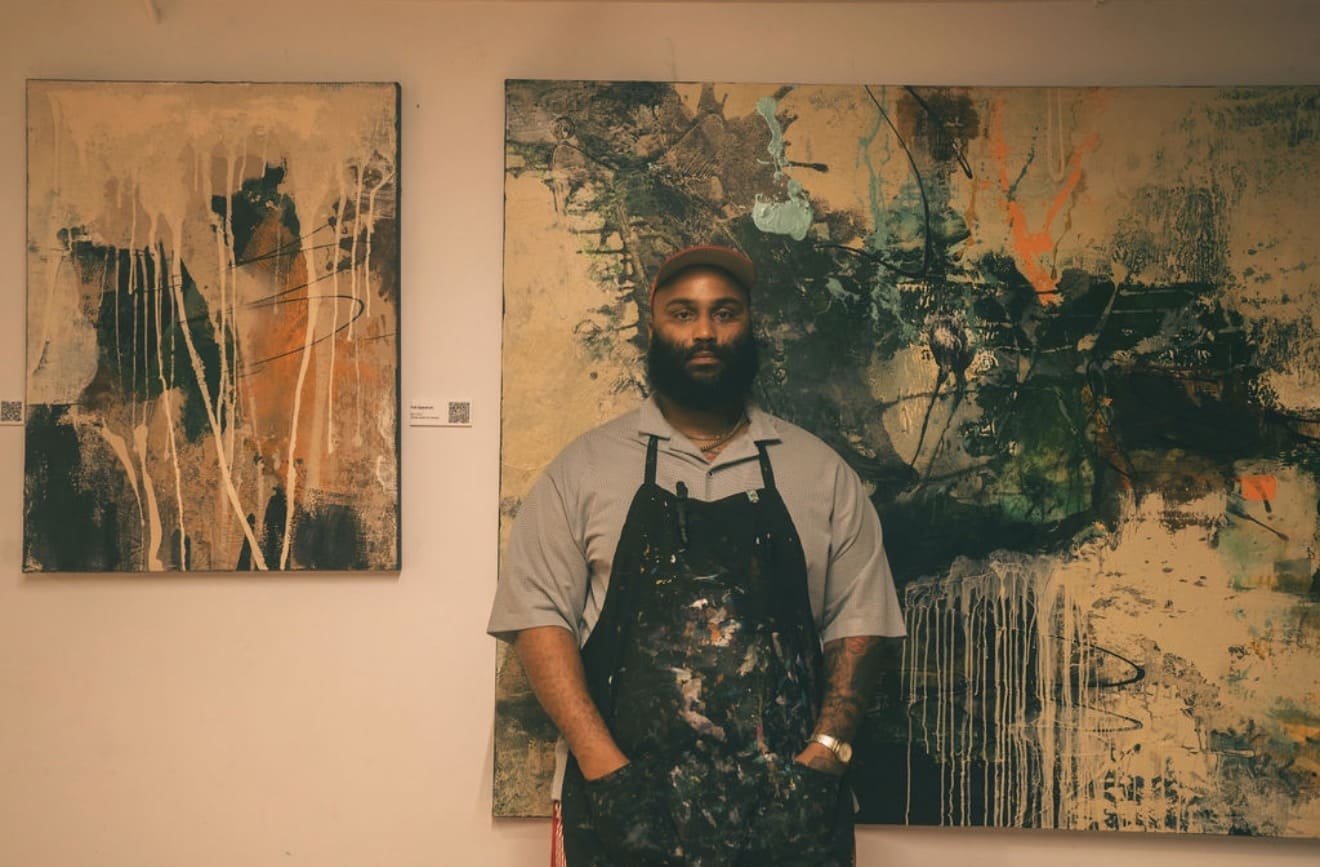
There is something revealing about the way Stephen Williams approaches a canvas. His works are physically imposing, often spanning several feet, yet the underlying emotions they hold can be surprisingly quiet. Themes of vulnerability, restraint, uncertainty, and acceptance anchor his practice. These are not subjects traditionally encouraged in a society where men are expected to remain emotionally guarded, particularly within the cultural pressures surrounding Black masculinity.
Working out of downtown San Diego, Williams embraces these internal landscapes as the core of his abstract painting. Rather than depicting recognizable figures, he constructs emotional environments through acrylic, scraped impasto, charcoal, and physical scale. His work offers an unconventional form of self-portraiture where internal experiences replace physical likeness as the true subject.
The Canvas as a Personal Journal
For Williams, abstraction provides a way to examine raw emotion without illustrating it literally. He approaches his canvases as visual journal entries, with each work recording a specific period of self-reflection, grief, or personal growth. This creative process begins long before paint touches linen. Through personal reflection, writing, and mindfulness, Williams identifies specific feelings that warrant deeper exploration before translating them into physical gestures on canvas.
Paint is applied generously, scraped away with palette knives, covered in dark washes, and reapplied. Vibrant color fields collide or retreat into heavy undertones, while dense textures interrupt smooth, exposed canvas to create immediate visual tension. Unlike written journal entries, however, these compositions do not offer explicit narratives. They capture and preserve the underlying feeling of a moment rather than the event itself.
Between Control and Expression
A central quality of Williams’ paintings is the balance between restraint and release. In compositions where expansive black and muted slate surfaces dominate the canvas, small concentrations of color interrupt the gloom. These isolated gestures hang suspended within dark grounds, evoking a sense of emotional containment and proving that abstract expression does not always need to be explosive.
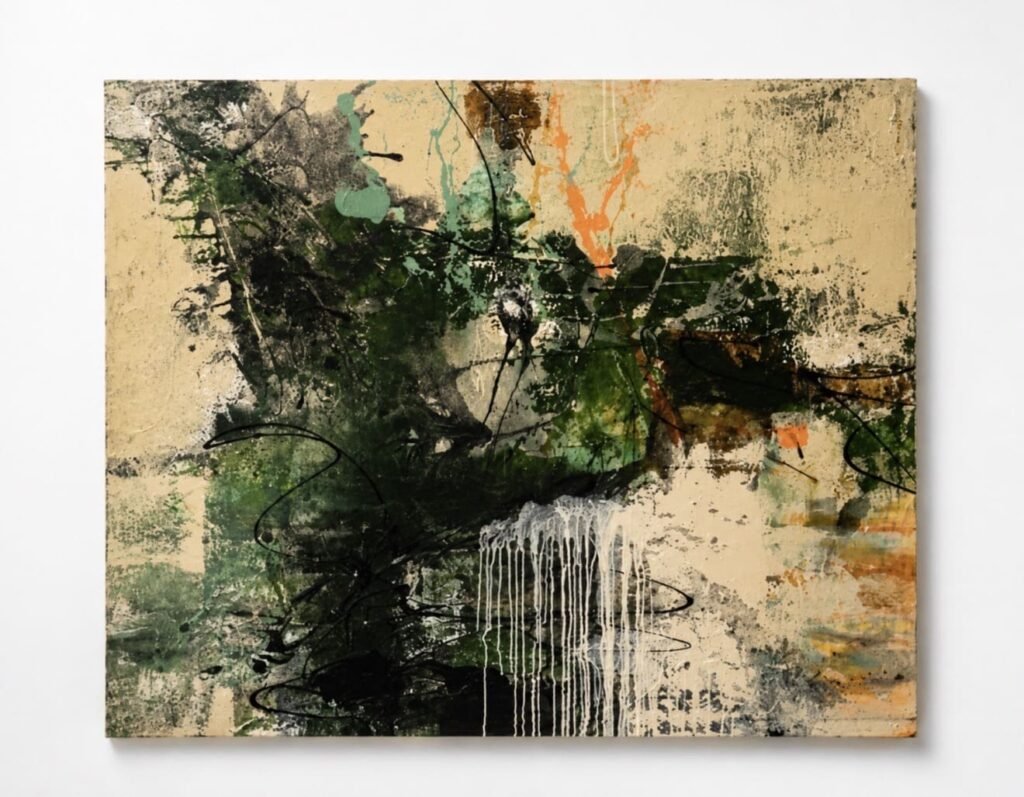
In other works, broad passages of deep green, earth tones, and raw canvas intersect with loose gestural lines, scraped textures, and cascading drips. Accents of orange and mint introduce moments of contrast, allowing the surface room to breathe. What initially appears chaotic reveals an underlying structural balance, a duality that mirrors Williams’ ongoing commentary on masculinity. Here, restraint can represent discipline, but it can also signal suppression; vulnerability may seem fragile, yet it demands immense courage.
Reconsidering Masculinity Through Abstraction
Williams directly confronts these societal expectations in works like Rules of Masculinity, Stop Crying, and Everything Is Fine. Their titles reference familiar mandates that instruct men to maintain composure and suppress emotional vulnerability. By exploring the psychological weight of these rules through pure abstraction rather than figurative scenes of struggle, Williams invites viewers into the internal experience of those moments. This autobiographical approach allows him to speak to his identity as a Black man without forcing his personal journey to serve as an exaggerated proxy for an entire community.
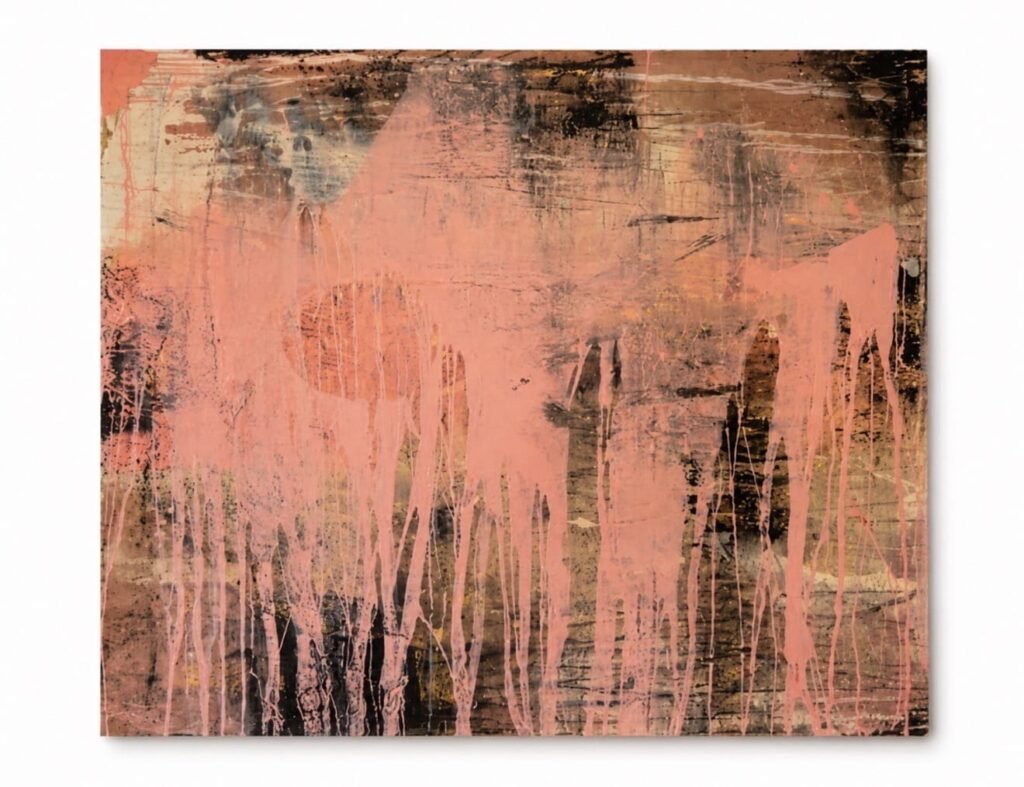
Conversely, works such as Stay Grounded, Rest, Enough, and Full Spectrum examine balance, self-acceptance, and emotional freedom. In the large-scale mixed-media painting Full Spectrum, contrasting feelings confidence, joy, grief, fear, and peace coexist on a single surface. Rather than compartmentalizing these states, the composition treats them as interconnected aspects of human experience, demonstrating that a canvas can hold contradictions without needing to resolve them immediately.
Expanding Beyond the Studio
This reflective methodology extends beyond Williams’ personal studio practice. As a Certified Art Therapy Practitioner and the founder of The Hyangle, a downtown San Diego gallery and wellness space centered on “Healing from a Higher Angle” he bridges fine art with community wellness. Through workshops integrating breathwork, journaling, and intuitive painting, he guides others in using abstract art as a tool for emotional exploration.
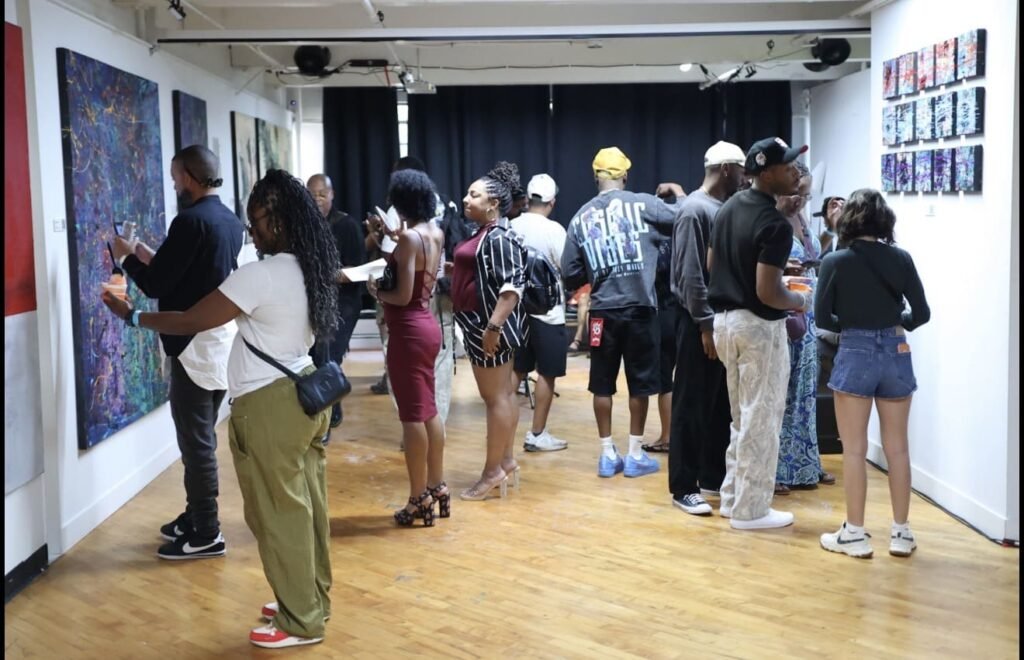
While his exhibition paintings stand independently as fine art, the therapeutic practices informing his community space continually enrich his studio work. Making art for Williams is not simply about producing objects for collection; it is an active method for examining inner life.
A Portrait Without a Face
By bringing private emotional states to a monumental scale, Williams executes a powerful reversal: feelings that are often kept hidden are given a physical presence large enough to command an entire gallery wall. His paintings ask viewers to sit with uncertainty, contradiction, and the unsaid, offering an ongoing autobiography without relying on traditional portraiture. Ultimately, his work asserts a compelling truth: emotional honesty does not diminish strength; it serves as one of its most powerful forms of expression.
Discover More & Connect:
To explore Stephen Williams’ original artworks, upcoming exhibitions, and community workshops, visit The Hyangle.