

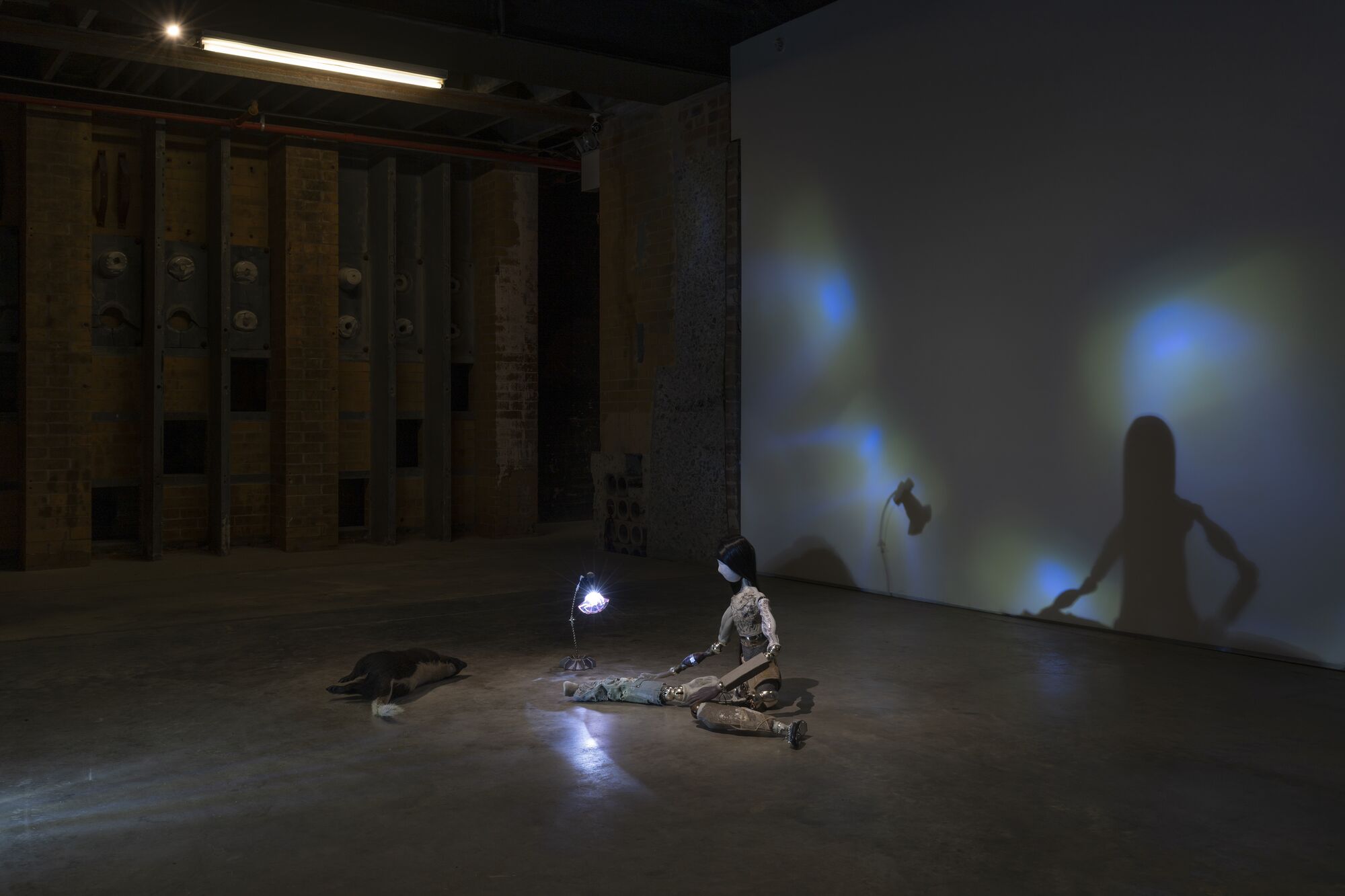
In a dimly lit basement room at New York’s SculptureCenter, ventriloquist Sophia Becker carefully adjusted the articulated limbs of a uncanny, long-haired doll dressed in scrap metal and medical materials.
“Oh god that feels good,” the doll chirped in a girlish voice, lamenting her stiff, untouched existence as a museum display.
The live performance was an activation for “Ideal Space for Music,” the solo exhibition by Mexico City–based artist duo ASMA comprising Hanya Beliá and Matias Armendaris. Blending puppetry, sound design by DJ Esra Canoğullari (8ULENTINA), and immersive spatial interventions, the show captured the essence of ASMA’s practice: an exploration of the collective subconscious through uncanny, hybrid materials.
Breakthrough Year for a Collaborative Force
The past year marked a major turning point for the duo, represented by Mexico City’s PEANA and House of Gaga (Los Angeles/Guadalajara). Following their institutional debut at SculptureCenter, ASMA opened “Wander & Pursuit” at the Museum of Contemporary Art Detroit (MOCA Detroit), alongside upcoming high-profile features at Art Basel and the Singapore Biennale.
Key Milestones for ASMA
| Exhibition / Event | Location | Core Focus / Themes |
| “Ideal Space for Music” | SculptureCenter, NYC | Subconscious landscapes, psychological dolls, hybrid materials |
| “Wander & Pursuit” | MOCA Detroit / House of Gaga LA | Corporate spaces, medieval/chivalric archetypes, present-day anxiety |
| Upcoming Presentations | Art Basel & Singapore Biennale | Expanding spatial installations on an international scale |
Dolls, Psychoanalysis, and the Subconscious
For “Ideal Space for Music,” ASMA turned SculptureCenter’s concrete basement into a dark, subterranean “bunker of the mind.” The installations included metal spheres, video art, soundscapes, ink paintings, and found-object light fixtures anchored by intricate, disturbing dolls.
To build these figures, Beliá and Armendaris eschewed traditional sculpting in favor of layering found and fabricated materials:
- Scraps of denim & synthetic hair
- Clarinet components & sink faucets
- Dental impression trays & silicone
The duo drew heavy inspiration from art-historical and literary references, including Hans Bellmer’s surrealist, fetishized doll sculptures and Rainer Maria Rilke’s essays on Childhood Dolls, which explore the uncanny intersection between inert objects and human psychological projection.
Translating Between Two Minds—and Their Materials
ASMA’s origin dates back to 2016 in Mexico City’s historic center (Centro Histórico), where Beliá (a painter and writer) and Armendaris (a printmaker and draftsman) began sharing a studio. Surrounded by the neighborhood’s collision of ancient history, industrial scrap, and street trade, the two artists, who are also romantically involved, gradually merged their practices into a unified sculptural language.
Rather than imposing a strict, pre-planned vision onto their mediums, ASMA approaches art-making as a triadic collaboration: Beliá, Armendaris, and the material itself.
“We have different images in our minds of what the work will be because we have two different minds,” Beliá explained. “In the process of making the work together, figuring it out, we end up somewhere we could have never imagined.”
Slow Craft in a Fast Era
In recent projects, ASMA has expanded from standalone sculptural objects to full-scale “psychological landscapes.” Their work examines contemporary anxiety, hybridity (the natural vs. the artificial), and the hidden forces shaping built environments.
Crucially, ASMA rejects shortcuts. They often teach themselves complex, labor-intensive techniques such as the ancient Egyptian glass-casting method pâte de verre purely through trial, error, and archival texts rather than formal instruction.
In an era increasingly dominated by AI-generated media and rapid digital production, ASMA’s insistence on slow, tactile experimentation serves as a grounding force, turning centuries-old techniques into futuristic meditations on the human psyche.