

New York is a deeply sick town and not in the colloquial sense. It is morbid, ill, and macabre. This rot springs directly from how disastrously each passing generation emphasizes the “New” in New York: Forget what came before you. Just accept that things change. Enjoy the present while it lasts.
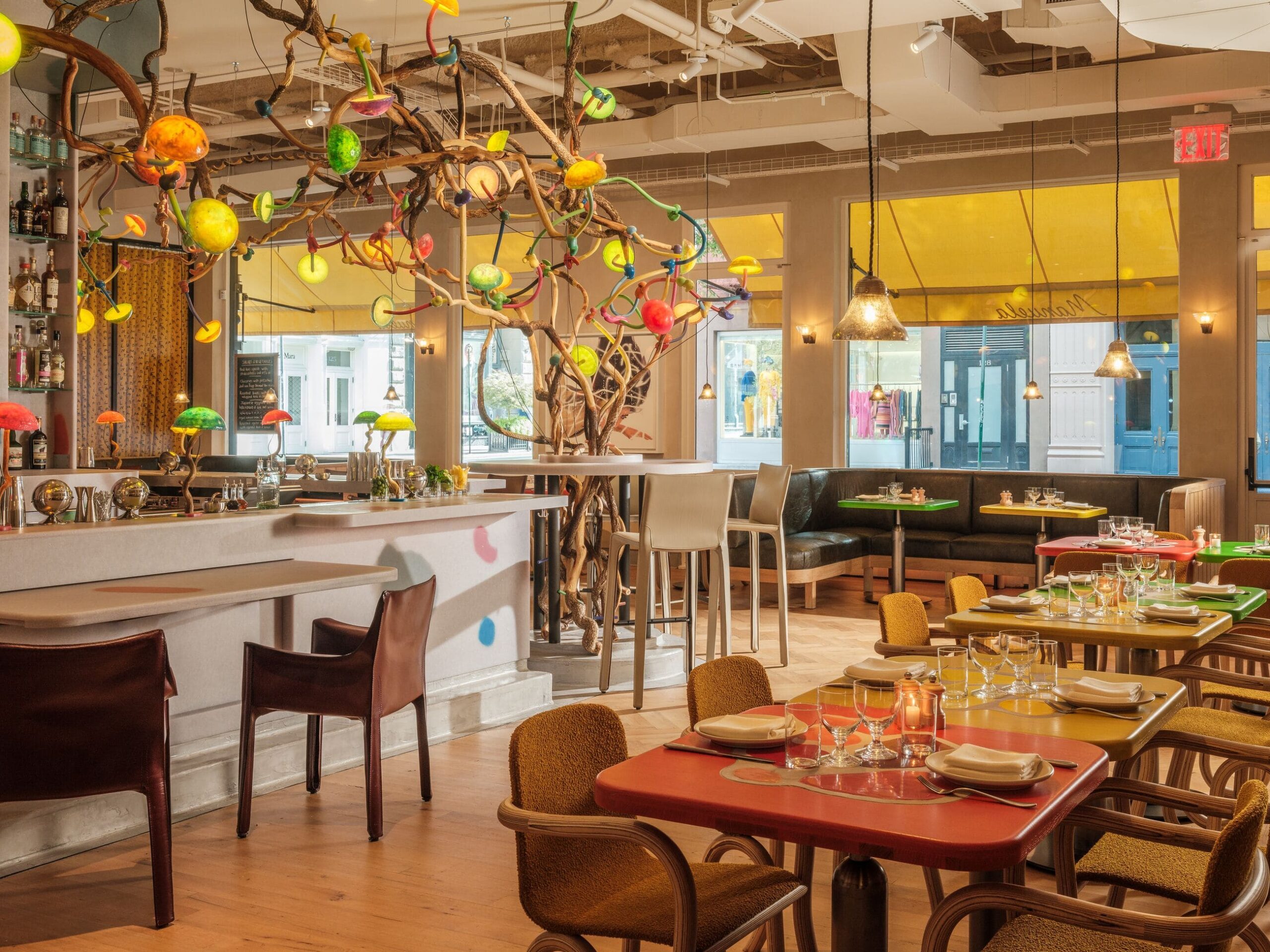
Yet, sitting inside Manuela, the pristine new SoHo establishment opened by Hauser & Wirth’s hospitality arm, Artfarm, only one overwhelming realization takes hold: our present sucks. To be direct, Manuela itself is lovely. The food is undeniably excellent, and the service is even better. But the surrounding streets feel blandly decadent and depraved, and Manuela is inevitably caught in the crossfire of SoHo’s relentless gentrification.
1971 vs. Today: A Tale of Two Prince Streets
The spatial irony of Manuela’s location at 130 Prince Street is impossible to ignore when measured against neighborhood history:
- 127 Prince Street (1971): Once the home of Gordon Matta-Clark’s legendary artist-run restaurant, FOOD. Built as a community hub, it offered struggling artists affordable meals and a warm kitchen.
- 127 Prince Street (Present): The address no longer houses Matta-Clark’s vision of mutual aid it is now operated by Marc Jacobs.
- 130 Prince Street (Present): Across the cobblestones at Manuela, the “artsy types” now dine on a $42 half-chicken, $26 steak tartare, $16 ham biscuits, or a $175 bone-in ribeye for two. Everyone inside looks impeccably fed; the struggling artist has been priced out of the room entirely.
High Art Meets Corporate Luxury
The dissonance deepens inside the restaurant’s interior. Entry requires navigating past a locked “V.I.P.” room visible through the glass, featuring a seven-meter mosaic table by Rashid Johnson a piece framed as a tribute to the Central Park Five, tucked safely inside an exclusive, cordoned-off private dining suite.
In the main dining room, high-value collection pieces watch over tables painted in primary-school colors:
- A Philip Guston painting depicting his wife, Musa.
- A panicked portrait by Cindy Sherman.
- A signature Louise Bourgeois spider guiding patrons down toward the restrooms.
- A sprawling Rita Ackermann mural looming over diners with scribbled text asking: WHAT DID YOU DO TODAY?
While Manuela’s mission statement claims that its culinary culture is guided by the belief that “art and life are indivisible,” the experience often feels more like a hollow parody. Surrounding yourself with insured museum-grade masterworks while eating dinner borders on the subtly unsettling, echoing the commercialization of art seen in pop-up “experiences” like Luna Luna or immersive Van Gogh exhibits.
“All Anyone Does Anymore Is Eat Dinner…”
A visit to the adjacent McNally Jackson bookstore yields a fitting thesis for the evening, found within Gary Indiana’s late-80s Village Voice collection, Vile Days:
“I have avoided New York nightlife for years. Everything always looks to me like a stale parody of something else. Sexual opportunity is dead. So is romance. All anyone does any more is eat dinner, take meetings and die.”
Thirty-seven years later, Indiana’s critique remains airtight. Manuela delivers warm hospitality, exceptional service, and a sublime atmosphere for gossip or business. Yet, as you step back onto Prince Street, the surrounding neighborhood serves as a reminder that in modern New York, history is perpetually erased to make room for a sleeker, costlier present.