

Born in 1949 in Aalst, the Netherlands, Wim de Groot discovered his calling as an artist at an early age. At just fifteen, he expressed his ambition with a declaration that would shape his future: “I want to become a painter!” This early determination marked the beginning of a lifelong engagement with artistic expression, observation, and the exploration of human experience.
De Groot’s artistic journey developed through years of study, experimentation, and professional involvement with art. In 1977, he presented his work publicly for the first time in Lochem, where it attracted attention from the regional press. One review described his art as a reflection of the artist’s fears, doubts, and moments of joy, noting its ability to transcend ordinary reality and confront profound emotional depths. This early recognition anticipated the introspective qualities that would become central to his artistic practice.
Art History, Restoration, and Visual Discovery
An important chapter in De Groot’s professional life unfolded during his work as a restorer at the Rijksmuseum. There, he immersed himself in the designs for the sixteenth-century stained-glass windows of St. John’s Church in Gouda. His engagement with this historical material eventually contributed to the anthology The Seventh Window, reflecting his sustained interest in the relationship between artistic heritage and visual interpretation.
His experience with historical art helped shape a distinctive visual language informed by artistic traditions across centuries. Rather than privileging one period or movement, De Groot approaches art history as an expansive field of ideas, forms, and possibilities. This openness allows different influences to coexist within his work, creating compositions that move beyond conventional stylistic boundaries.
Alongside his longer painting projects, model drawing became an important part of his practice. Its immediacy offers a counterpoint to the extended process of developing a painting. Through direct observation, he captures fleeting gestures, bodily presence, and moments that might otherwise disappear. His broader artistic vision brings together the city, contemporary events, and, above all, humanity.
Maternitas et Postpartum: Confronting the Ambiguities of Motherhood
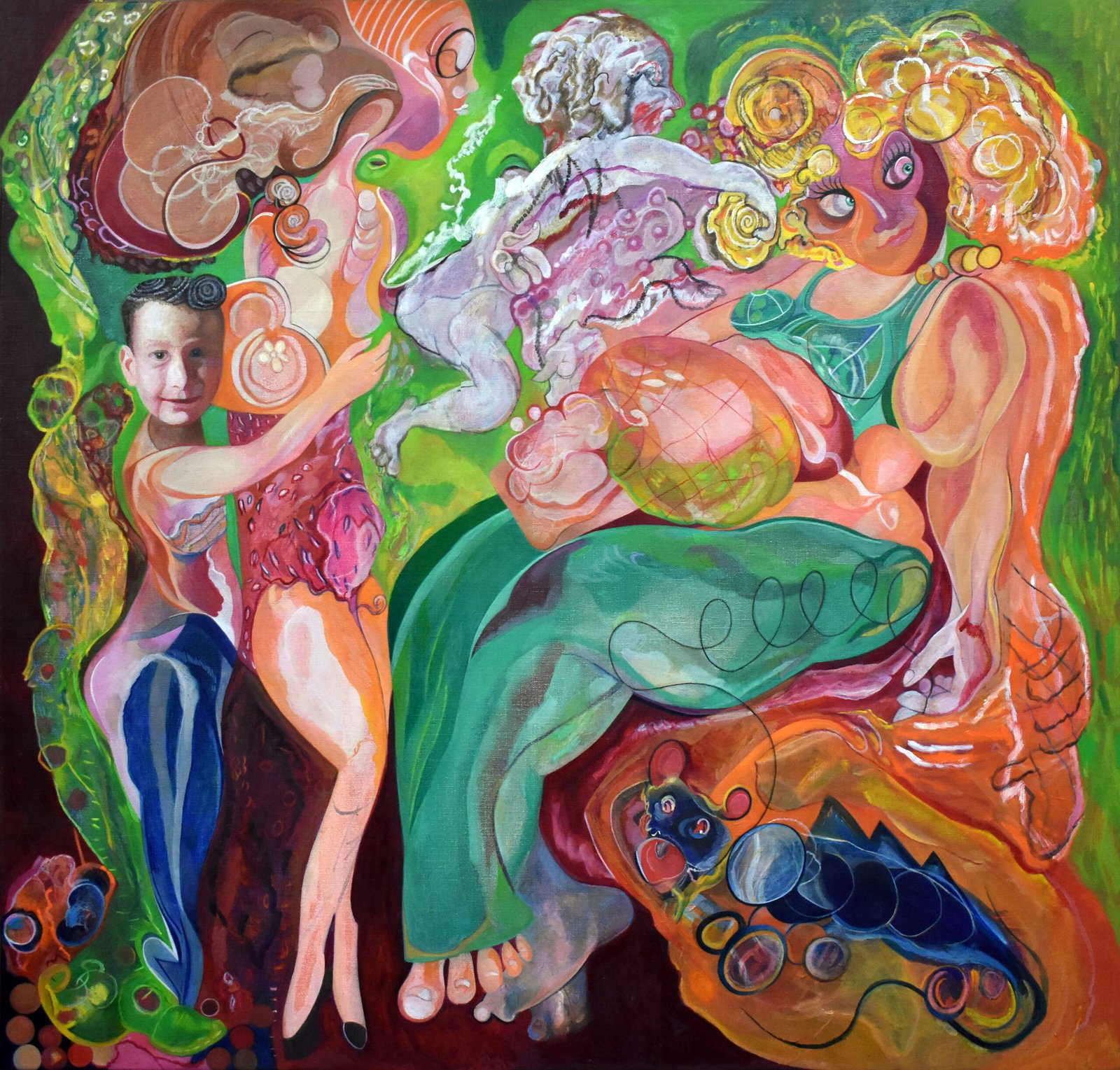
De Groot’s painting Maternitas et Postpartum (2026), an oil-on-canvas work measuring 90 × 95 cm, represents a deeply personal investigation into motherhood, birth, memory, and emotional conflict. Through a complex arrangement of figures, symbolic objects, and vivid colours, the artist examines the contradictions that can exist between biological connection and psychological experience.
The composition unfolds within an abstract, lush environment dominated by shades of lemon yellow, leaf green, viridian, phthalo green, and olive green. These colours envelop the figures, connecting their bodies with the surrounding vegetation. A deep carmine-red area, created with madder lake, introduces associations with blood, physicality, and the experience of childbirth.
At the centre sits a voluptuous woman resting on an orange-red beanbag. Her mask-like face, exaggerated eyes, elaborate yellow curls, and turquoise clothing give her an almost theatrical appearance. Her body departs from naturalistic representation, particularly around the abdomen, where the artist introduces unusual, surreal transformations. The figure becomes simultaneously recognisable and alienated, inviting questions about identity, sexuality, and reproduction.
To her left, an elongated female figure dressed in a cyclamen-red swimsuit presents a cherub-like baby. Although the standing woman appears to mediate the encounter, the seated figure averts her gaze from the infant’s tender gesture. This exchange creates the painting’s central ambiguity: the child is offered to the woman who appears to have given birth, yet the expected emotional connection remains uncertain.
A small boy in a colourful ballet costume stands at the far left, looking directly at the viewer. His position recalls the Renaissance ammonitore, a figure who draws attention to the central action without fully participating in it. His presence transforms the transfer of the baby into an explicit visual statement, encouraging viewers to confront the scene rather than observe it passively.
Elsewhere, a small, dragon-like toy introduces another layer of symbolism. Originally inspired by a stuffed animal belonging to the artist’s young neighbour, the figure gradually transformed during the painting process into a blue monster with red ears. A thin black thread connects it to the seated woman, suggesting an ambiguous relationship between the two forms.
Personal History as a Source of Artistic Inquiry
Behind the painting’s unusual imagery lies De Groot’s difficult relationship with his mother. He describes how his childhood was shaped by emotional distance, strict religious expectations, and a lack of openness surrounding the body and sexuality. His mother, an Orthodox Christian, raised nine children and sought to maintain a disciplined household, particularly following the death of his father when De Groot was sixteen.
The artist recalls experiences that left him confused and unsettled, including moments when ordinary childhood curiosity about the human body was met with anger or reprimand. These memories contributed to a lasting sense that his mother’s physical identity and emotional world remained inaccessible to him. As he explains, he may have spent much of his life searching for an understanding of who his mother really was.
Religious expectations also shaped his adolescence. His appearance, friendships, reading choices, hairstyle, and musical interests were frequently criticised, while his ambition to become an artist encountered strong resistance. His decision to study at the Rijksakademie voor Beeldende Kunsten in Amsterdam became a point of conflict, deepening the distance between his artistic aspirations and his family environment.
Over time, De Groot recognised that his rejection of his mother’s values also involved rejecting aspects of himself. The resulting tension between resentment, longing, and the desire for reconciliation became an increasingly significant element of his artistic exploration. Maternitas et Postpartum emerges from this history, transforming private memories into an unsettling visual meditation on the complicated bonds between parent and child.
Intuition, Transformation, and the Painting Process
De Groot’s creative process is guided by intuition rather than a fully predetermined plan. He describes how a painting develops gradually, revealing possibilities that he could not have anticipated at the beginning. In Maternitas et Postpartum, the transformation of the woman’s abdomen exemplifies this approach. Its unusual, almost mechanical form suggests an autonomous cycle of reproduction, in which pregnancy and birth become an impersonal, recurring process.
For De Groot, intuitive painting involves following visual discoveries even when their meanings are not immediately clear. Each line and brushstroke must feel necessary, although the questions raised by the finished image may remain unresolved. This openness allows the work to retain its psychological complexity without reducing it to a single interpretation.
Motherhood Across Different Works
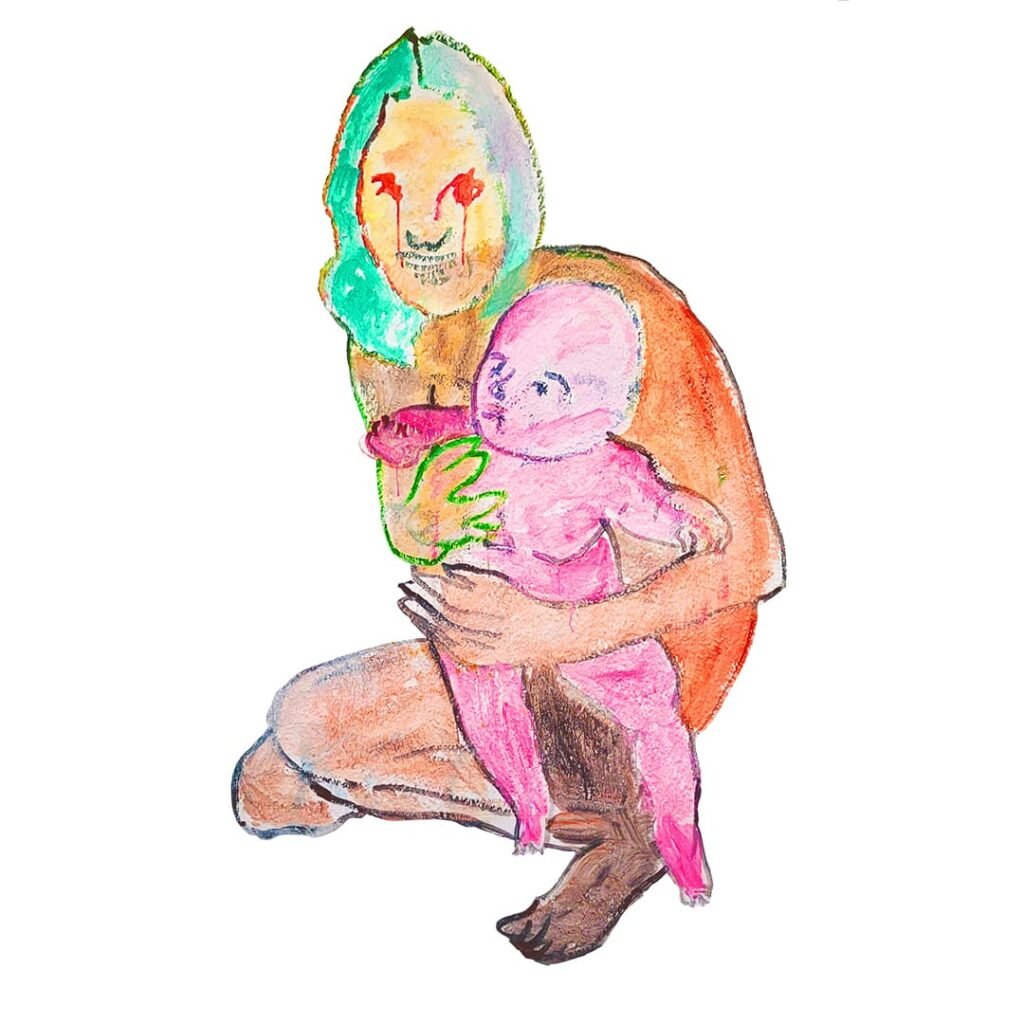
The themes explored in Maternitas et Postpartum connect with De Groot’s earlier works, including Mother and Child Reunion I (2011), a gouache composition on wallpaper measuring 173 × 114 cm, and Mother and Child Reunion II (2012), a watercolour on paper measuring 29.6 × 20.2 cm. Together, these works demonstrate his sustained engagement with the relationship between mothers and children as a subject capable of carrying emotional, symbolic, and autobiographical significance.
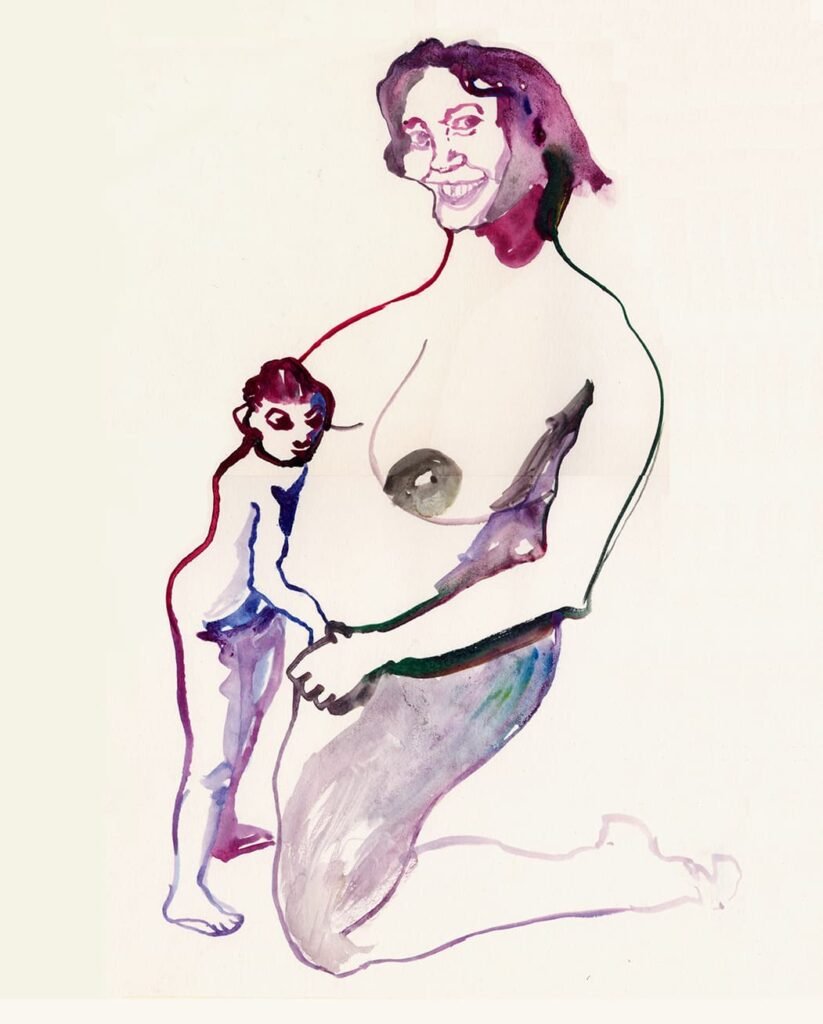
Rather than presenting motherhood as an uncomplicated ideal, De Groot examines its contradictions, exposing the distance that can exist between social expectations and private experience. His imagery challenges viewers to consider how family relationships are shaped by memory, authority, vulnerability, and unresolved emotions.
Presenting a Distinctive Artistic Vision
From 2025 onward, Wim de Groot has presented his paintings, figure drawings, and independent works through his website, wimdegroot.nl, and on Instagram under #vvimdegroot. His practice brings together historical awareness, observational drawing, symbolic imagery, and personal reflection.
Through his willingness to confront difficult experiences, De Groot creates art that extends beyond autobiography. His paintings invite viewers into a world where the human body becomes a site of memory, relationships remain open to interpretation, and the creative process offers a way to investigate unresolved questions. By combining an expansive knowledge of art history with an intensely personal visual language, he continues to explore the complexities of being human.