

Bianca Biji remembers no time before drawing. By the age of three, she was already making marks and applying paint, and the habit never left her. Born in 1970 in Cluj-Napoca, Romania, she grew into an artist who treats a blank surface as an open question rather than a problem to be solved in advance.
Where It Began
From about twelve until nineteen, she studied at an art school with a focus on graphics. Those years gave her a grounding in drawing and the discipline of the printed line. Then, at twenty, she left Romania for Brussels, Belgium, and stayed.
In the city, she enrolled at La Cambre and spent five years learning etching. The jury distinguished her work. Etching asks for patience: a plate is worked, bitten, inked and pulled, and the artist waits for what the press will reveal. One imagines that long apprenticeship in anticipation may have shaped how she now handles surprise, though that is a thought offered from outside the studio.
No Map, Only Colour
When Biji sits down to paint, she usually has no sketch and no detailed project. Instead, colour takes charge. She lets it run, then watches. Shapes begin to surface, and she tries to read them, the way a person might read clouds, and now and then a form hands her a message or an idea.
Her approach is not rigid. On other occasions she starts from a very free drawing and brings colour in afterward. Whichever way she enters, the painting is allowed to say something before she does. Only when it is finished does she give it a title, so the name arrives like a late guest who turns out to know the house.
The Room Where Nobody Votes
Biji paints, above all, for her own psychological sanity and for joy. She describes making art as a private space where compromise does not exist. Nobody there asks what a gallery might want, and she does not make work to meet such wishes.
There is freedom in that, and a certain stubbornness too. It is the stance of someone who values the act of making over its reception, and who has found that the one does not necessarily spoil the other. Her pictures can be played with, pushed, abandoned or rescued because they answer to no committee.
The Pleasure of Ripping Things Up
Not every painting survives her own judgment. When one no longer satisfies her, she cuts or tears it into pieces. Then she joins the fragments with different kinds of tape, and sometimes, later on, she glues the finished arrangement onto a plain ground.
She finds the whole business playful, and that word matters. It suggests that disappointment, for her, is not an ending but a supply of raw material. A canvas she dislikes becomes confetti with a purpose. Looking at it from outside, one might see a tidy metaphor: rejection turned into invention, fragments made to fit. Biji has not put it that way, so it remains an observer’s reading. What is plain is the sense of ease in the method, the willingness to treat a failed painting as a beginning.
Brussels, Vence and the Printed Page
Since leaving school she has shown steadily, mainly in Brussels and in Vence, in the south of France. Her name has appeared on the walls of Galerie Art Pol, Espace Latitude and Galerie DS, and in spaces as varied as the Théâtre de la Toison d’Or, the Gare de Watermael-Boitsfort and the Château de Seneffe. Ateliers have welcomed her too, among them the Atelier de l’Escarpolette and Atelier Kasba in Brussels and Atelier B in Vence, where she returned more than once. Neighbourhood art routes in Boitsfort, Hoeilaart and Tervuren, along with Nero, Bulex and Futurart, add to the picture of an artist who goes where the work is welcome.
Books run alongside the exhibitions. In 1997, Éditions Tandem published “Détails de Guerre.” Collaborative editions followed, including “Autoportraits,” “Carré Blanc” and “Gaspard, Melchior et Balthasar,” and she illustrated the children’s book “Orsolino.” The span of these projects shows a person comfortable with both the quiet of a studio and the company of other makers.
Neptune, a Saviour and a Politician
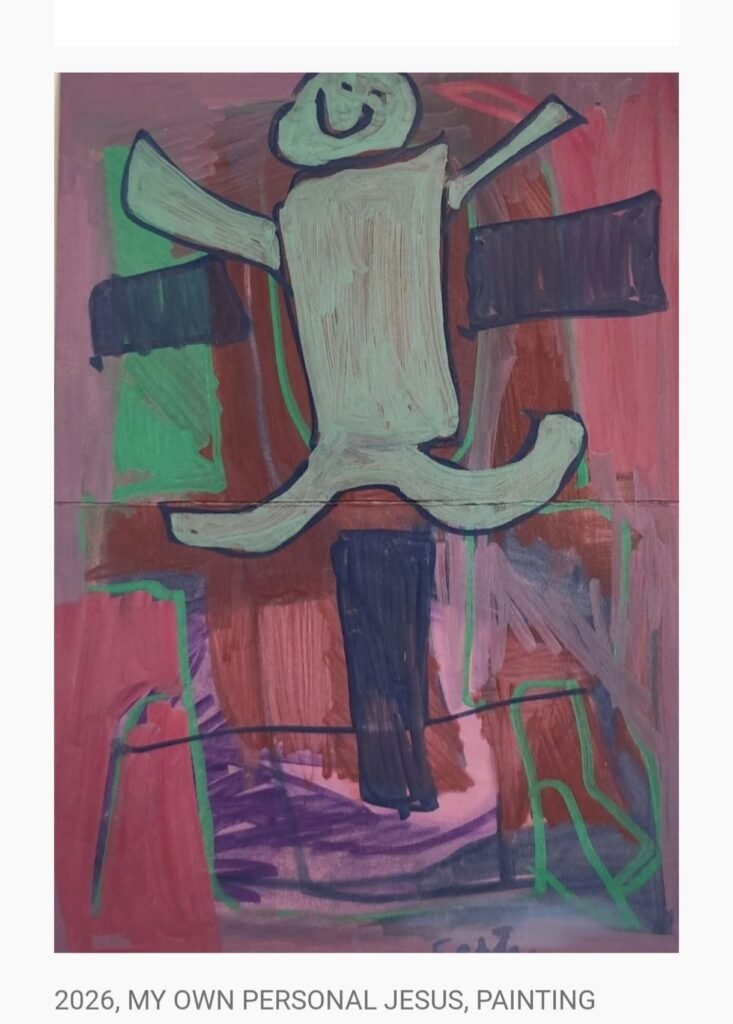
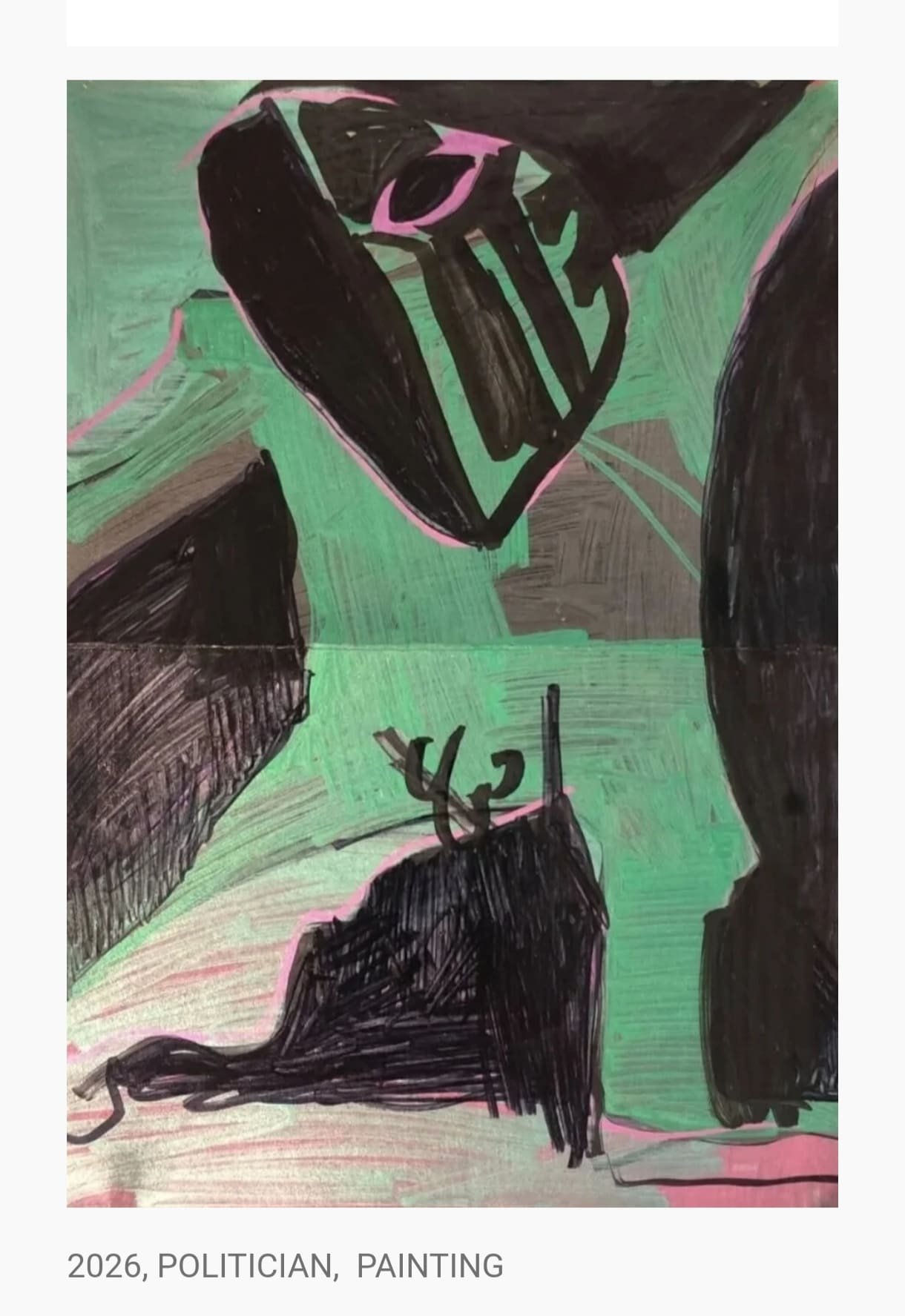
Her three paintings from 2026 carry names that could belong to three different conversations: “Neptune’s Fork,” “My Own Personal Jesus” and “Politician.” Nothing has been supplied about how they look, and nothing is claimed about what they mean. It would be wrong to pretend otherwise.
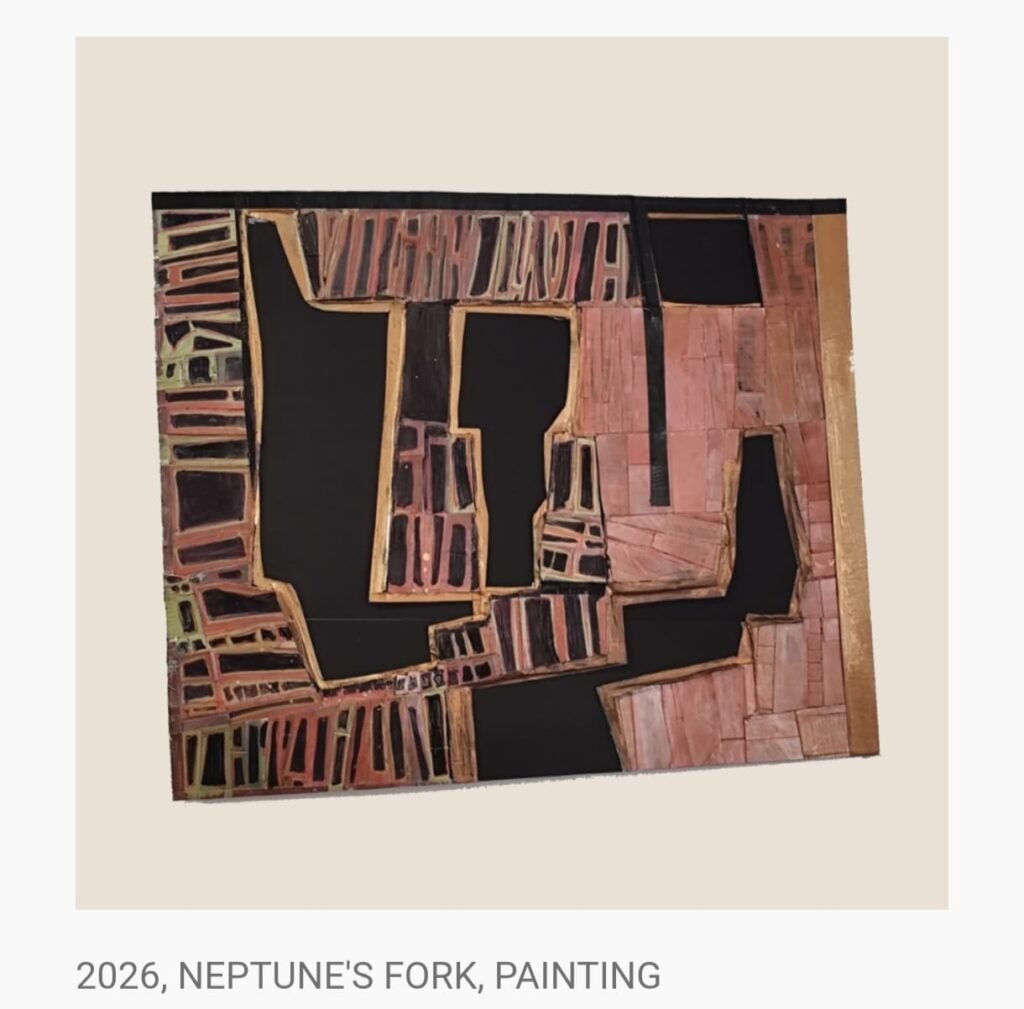
What one can say is how such titles are likely to come about. Because Biji names her work only once it is done, each phrase is presumably settled on a finished picture after the fact, a reply to whatever had taken shape. One title leans toward myth, another toward faith or irreverence, another toward public life. Together they hint at a mind that wanders freely among registers and does not tidy its references into a single theme. The painting arrives first; the words follow.
The Painter Who Keeps Playing
Bianca Biji began as a child with a pencil and a brush, trained as a printmaker, and settled into a way of working that depends on trust: trust in colour, in accident, in her own ability to recognise a form when it appears. She has exhibited and published for decades without allowing those occasions to dictate what happens in the studio. That room stays hers. In it, paintings are found rather than planned, failures are cut up and made new, and the point, as she tells it, is sanity and joy. Few reasons for making art are plainer, and few are harder to argue with.
Step Inside Bianca Biji’s Studio
Discover more of Bianca Biji’s intuitive paintings, follow her daily creative experiments, and explore her complete portfolio:
- Official Website: biancabiji.com
- Instagram: @biancabiji_
- Threads: @biancabiji_