

Adamo Macri’s artistic practice occupies an intriguing space between sculpture, photography, painting, video, and performance. Based in Montreal, the artist approaches visual expression as an evolving process in which objects, bodies, and constructed identities become interconnected. His work frequently examines questions of identity, contamination, transformation, and the delicate relationship between human existence and the natural world. Rather than treating an artwork as a fixed representation, Macri considers it an occurrence: something capable of changing meaning through its physical construction, presentation, and relationship with the viewer.
In Telltale Manual (2025), this approach takes a particularly compelling form. Through an elaborate photographic composition dominated by vivid red, Macri brings together concealment, theatricality, and biological hybridity. A partially veiled figure appears alongside a fantastical creature, creating an image in which the distinction between human and nonhuman, self and other, becomes increasingly difficult to maintain. The work is not simply a portrait but a carefully staged encounter with the unstable nature of identity.
The Evolution of a Recurring Character
An important element in understanding Telltale Manual is a distinctive hand puppet that has appeared in several stages of Macri’s artistic development. Resembling a primitive, youthful creature with an exaggerated, ravenous mouth, the puppet carries an unsettling mixture of innocence, appetite, and aggression. Its appearance suggests a character drawn from childhood imagination, yet its symbolism reaches toward something more instinctive and ancient.
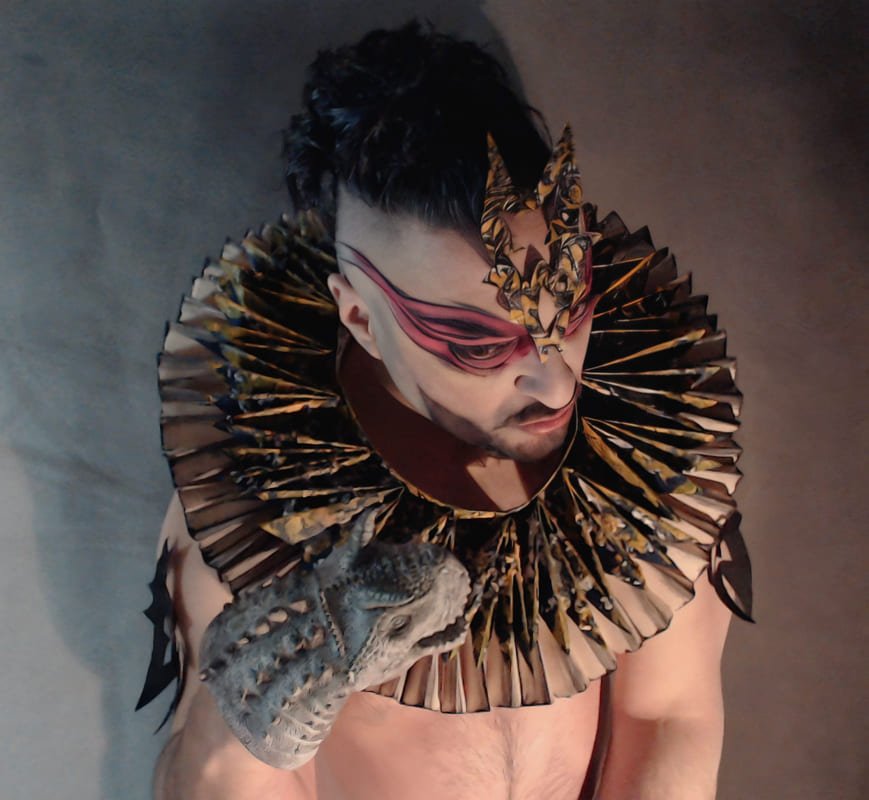
The character first emerges in Icono Emoter (2014), where a simplified version of the puppet establishes its visual and conceptual identity. One arm hangs downward, giving the figure a sense of physical presence, while the other rises toward its ruff, holding a small greyish reptilian dinosaur toy. The juxtaposition creates an unusual relationship between the two objects. The puppet appears simultaneously as a playful theatrical figure and a representation of humanity’s more primitive impulses.
Held by the artist, it functions almost as an externalized organ or disowned alter ego. Its presence suggests that certain aspects of human nature are not necessarily eliminated through cultural development but instead transformed, disguised, and incorporated into the performances of everyday life. The puppet becomes a means through which Macri can examine the relationship between instinct and civilization, using the visual language of children’s entertainment to approach more complicated psychological territory.
From Puppetry to Performed Identity
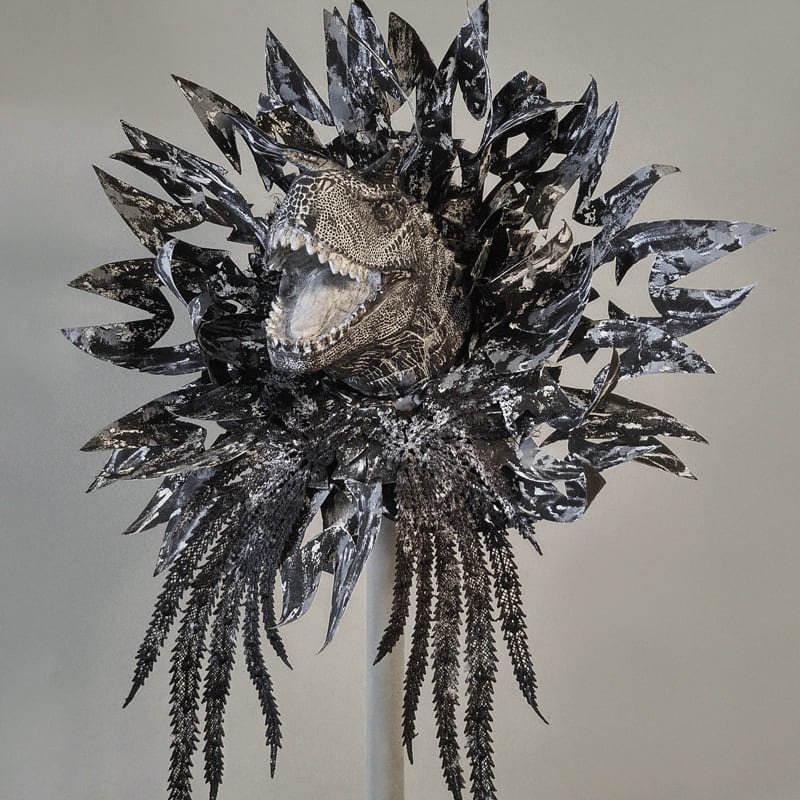
The motif develops further in Triffid II (2017), where the puppet reappears during a live gallery performance, worn by the artist himself. This transformation introduces a more direct relationship between the constructed character and the human body. Enveloped in plant-like leaves and presented in black and white, the figure begins to suggest an organism undergoing an uncertain process of mutation.
Puppetry traditionally involves a relationship between animation and control. A puppet appears to possess independent movement, yet its actions are determined by an external operator. Macri uses this inherent contradiction to explore the tension between autonomy and manipulation. When the puppet is worn by the artist, the relationship becomes particularly complex: the performer animates the character while simultaneously allowing the character to redefine his own physical appearance.
The monochromatic presentation reinforces this psychological tension. Reduced to essential contrasts, the figure becomes a study of opposing conditions: freedom and constraint, self and other, human and creature. Identity emerges not as something entirely self-determined but as something continuously staged, influenced, and reshaped through external forces.
Telltale Manual: A Portrait of Transformation
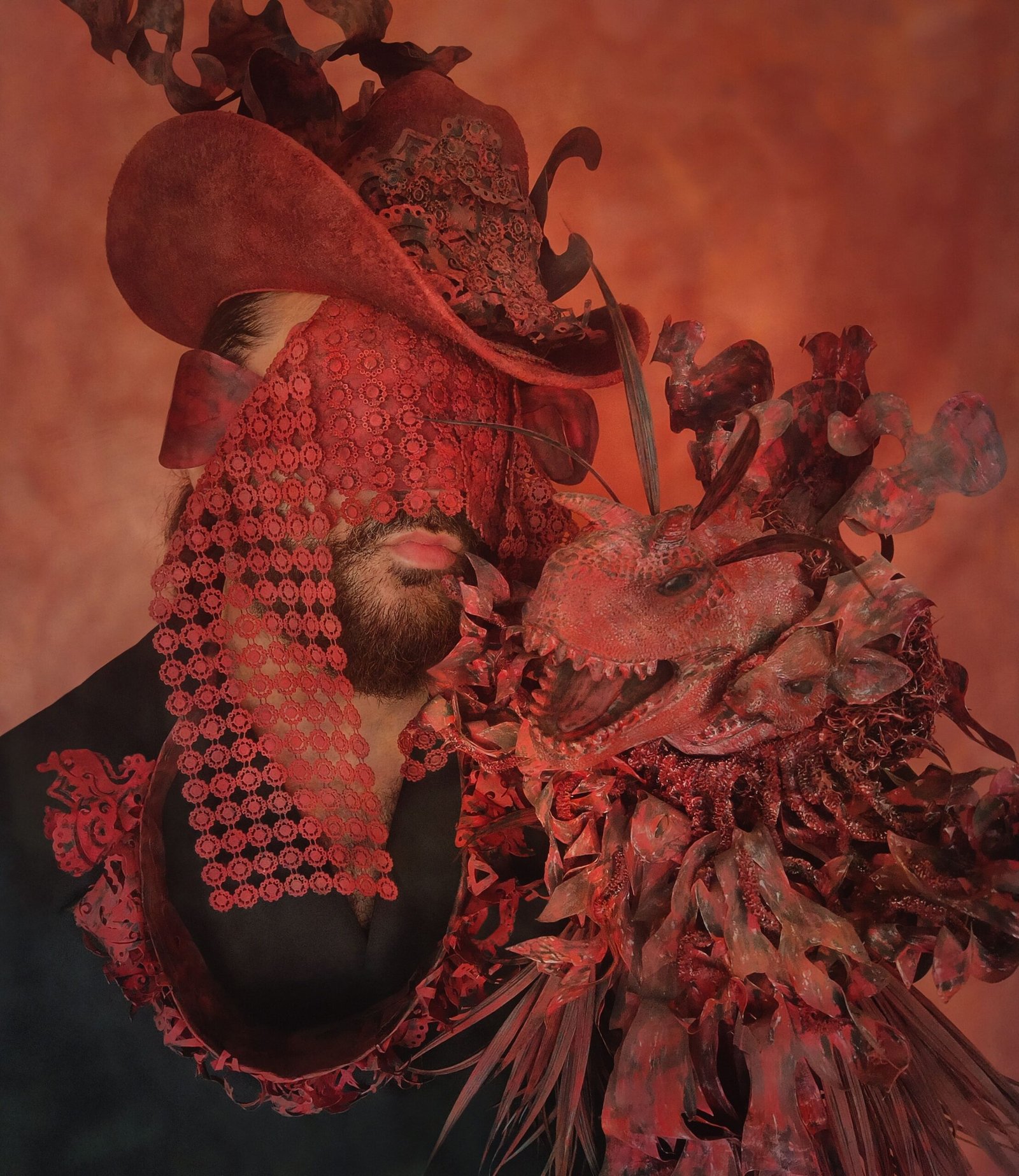
In Telltale Manual, the recurring character reaches its third significant transformation, identified as Triffid III. The puppet now appears with more elaborate foliage and is presented entirely in a striking red environment. The resulting composition brings together the artist’s interests in sculpture, costume, performance, and photographic image-making.
A solitary figure occupies the composition, almost engulfed by red. The veil, headpiece, creature, and surrounding atmosphere seem to merge into a continuous chromatic field. Delicate red lace partially conceals the face, while an elaborate arrangement of materials creates an imposing silhouette. Beside the figure, a fantastical organism leans inward, its appearance combining reptilian, floral, and fleshy qualities.
The relationship between these forms is deliberately ambiguous. The creature might be interpreted as a parasite, a guardian, an alter ego, or an external manifestation of something concealed within the figure. Rather than establishing a clear separation between the two, Macri creates an impression of intimacy and mutual dependence. The human presence appears neither entirely dominant nor entirely vulnerable, suggesting a shared existence in which both forms participate in the construction of a single identity.
The Language of Veiling and Concealment
The elaborate headwear and lace veil introduce associations with Baroque and Gothic portraiture, where costume, ornament, and fabric often communicate as much as facial expression. Yet Macri’s use of these elements moves beyond decorative display. Here, concealment becomes a deliberate artistic strategy.
By partially obscuring the face, the artist withholds the most recognizable feature of conventional portraiture. The viewer is denied complete access to the subject’s identity and must instead interpret the figure through its surrounding objects, textures, and gestures. The hat, veil, and creature function almost as extensions of the psyche, suggesting that identity is assembled through layers rather than revealed through a single defining feature.
This approach also challenges the traditional purpose of portraiture. Instead of presenting a stable individual for recognition, Macri constructs a psychological environment in which selfhood remains uncertain. The image becomes less concerned with who the figure is than with how identity is produced, concealed, and transformed.
Red as an Atmosphere of Contamination
Colour plays a decisive role in the work’s visual and conceptual impact. The nearly monochromatic red palette creates an atmosphere that is at once theatrical and unsettling. Red carries multiple associations, including blood, flesh, danger, devotion, desire, and ritual. By saturating the figure and its accompanying creature in the same colour, Macri eliminates many of the visual distinctions that might otherwise separate them.
This chromatic unity reinforces the idea of contamination that runs throughout his wider practice. The creature does not simply invade the human figure’s space; it appears to share its visual and psychological substance. The distinction between host and guest becomes uncertain, suggesting that identity is never entirely isolated or self-contained. Instead, it is shaped through constant exchanges between the individual and the surrounding world.
Importantly, Telltale Manual is constructed through physical materials rather than relying exclusively on digitally imagined surrealism. The mask, textile, veil, and creature are tangible sculptural elements assembled before the camera. Photography therefore becomes the final stage of a broader material process, documenting a constructed occurrence while preserving its theatrical intensity.
The Unruly Evidence of Identity
The title Telltale Manual brings together two seemingly opposing ideas. A manual suggests instruction, organization, and control, while a telltale sign points toward an involuntary revelation, something that escapes deliberate management. This tension provides a conceptual foundation for the photograph.
The figure appears carefully arranged, almost as though following a prescribed ritual of self-presentation. Yet the creature’s intrusion and the overwhelming red environment suggest forces that cannot be completely controlled. What is concealed inevitably produces signs of its presence, and what is carefully staged can reveal something unintended.
Through this work, Adamo Macri extends his ongoing exploration of transformation, performance, and the uncertain boundaries of identity. The evolution from Icono Emoter through Triffid II to Telltale Manual demonstrates how a recurring object can acquire increasingly complex meanings as it moves between sculpture, performance, and photography. The puppet becomes more than a recognizable motif; it develops into a symbolic counterpart through which the artist examines the relationship between instinct, self-presentation, and the natural world.
Ultimately, Telltale Manual offers no fixed resolution to these questions. Its power lies in the coexistence of concealment and revelation, attraction and unease, human presence and organic transformation. By turning a constructed portrait into a theatrical encounter between bodies and forms, Macri invites viewers to reconsider identity not as a stable possession but as an evolving condition, continually shaped by the things we reveal, the things we conceal, and the forces that exist beyond our control.
Discover More About Adamo Macri
Explore more of Adamo Macri’s artistic practice, projects, and creative journey through his official website and social media channels.
- Website: adamomacri.blogspot.com
- Facebook: facebook.com/Adamo.Macri
- YouTube: youtube.com/user/adamomacri