

The landscape genre has long been a site where private perception meets collective meaning. In the work of Lisa Tahar (b. Leipzig, 1963), this encounter is conducted with notable economy. Working in oil on canvas, Tahar began painting in 2018 following retirement from a series of earlier professions, and she has since developed a body of river landscapes that combine meditative calm with an occasional, pointed civic subtext.
Biography and Formation
Tahar has lived in Leipzig throughout her life, and her four children are now adults. Her artistic practice is self-directed and began late. Rather than the academic training that structures many careers, her formation draws on a long-standing admiration for the American painter Bob Ross, whose televised instruction made landscape painting widely approachable. Tahar’s debt to Ross is one of attitude, an openness to the idea that nature can be rendered by an attentive amateur, rather than one of method or style.
Her motifs are largely self-generated, though she occasionally works from images found online. This mixture of invented and sourced material situates her within a contemporary tradition in which the photograph, and increasingly the digital image, supplements direct observation.
The Poetics of Absence
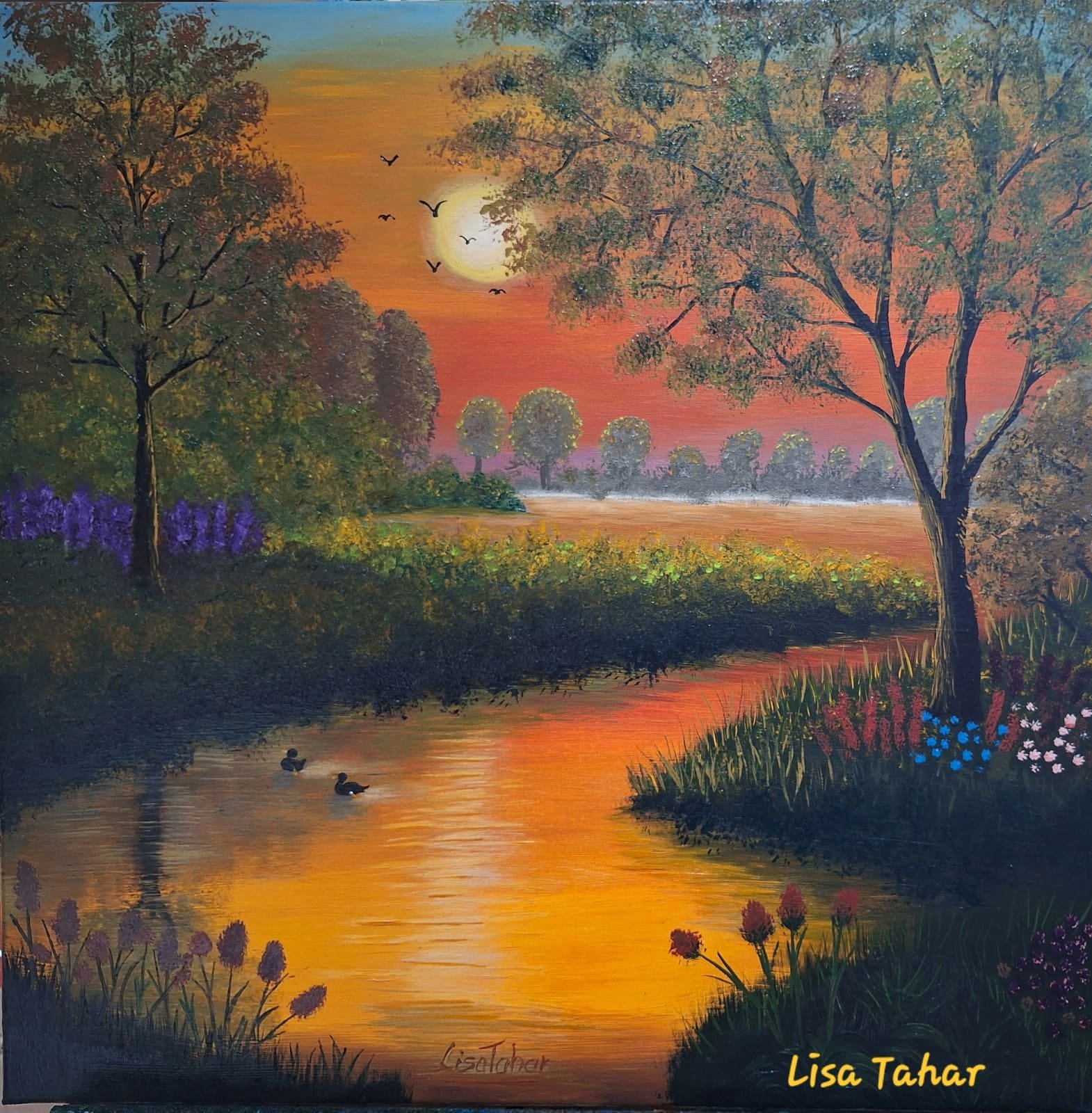
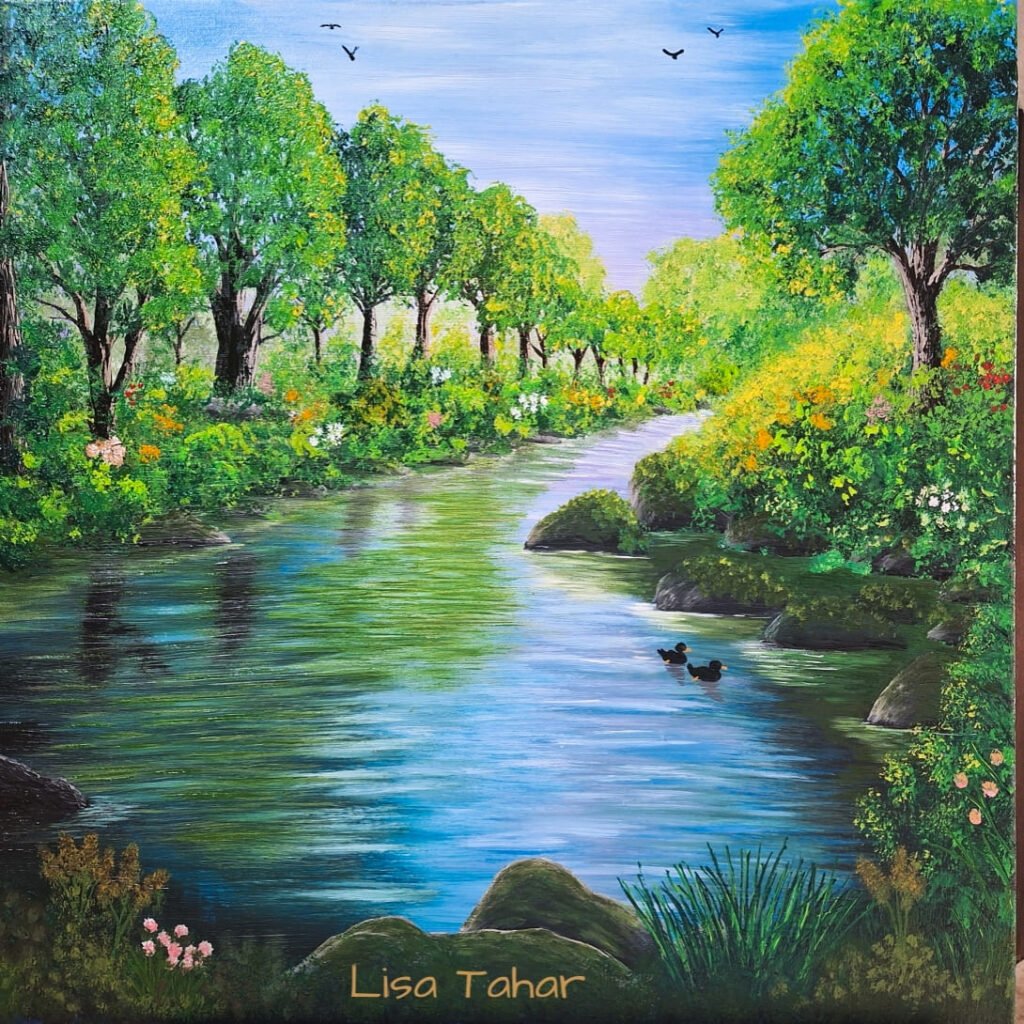
Two paintings, Summer Evening and Summer, establish the central vocabulary of Tahar’s practice. Both depict a river and a single pair of ducks swimming toward the bank. In Summer Evening the setting sun suffuses the scene; in Summer daylight reveals trees, flowers and stone-bordered banks.
What unites them is a deliberate programme of omission. Tahar describes the work as entirely free of distracting elements: no figures, no further fauna, no activity. This strategy aligns her with a lineage of Romantic landscape in which the unpeopled scene invites contemplation rather than narrative. Yet it also carries a contemporary inflection. In a visual culture saturated with noise, the refusal to include anything beyond nature itself becomes a gesture of resistance.
Tahar further asks that these pictures be experienced multisensorily: the sound of rippling water and the feel of a warm breeze are, in her account, part of what the viewer should receive. This synaesthetic aspiration is typical of landscape painting at its most immersive, where the image seeks to stand in for the occasion of being outdoors.
Winter Evening and the Political Landscape
Winter Evening complicates this serenity. Formally, the work presents a river at sunset in winter, distinguished by the use of warm colours to depict the cold season. The chromatic inversion alone is a notable choice, softening winter’s conventional austerity.
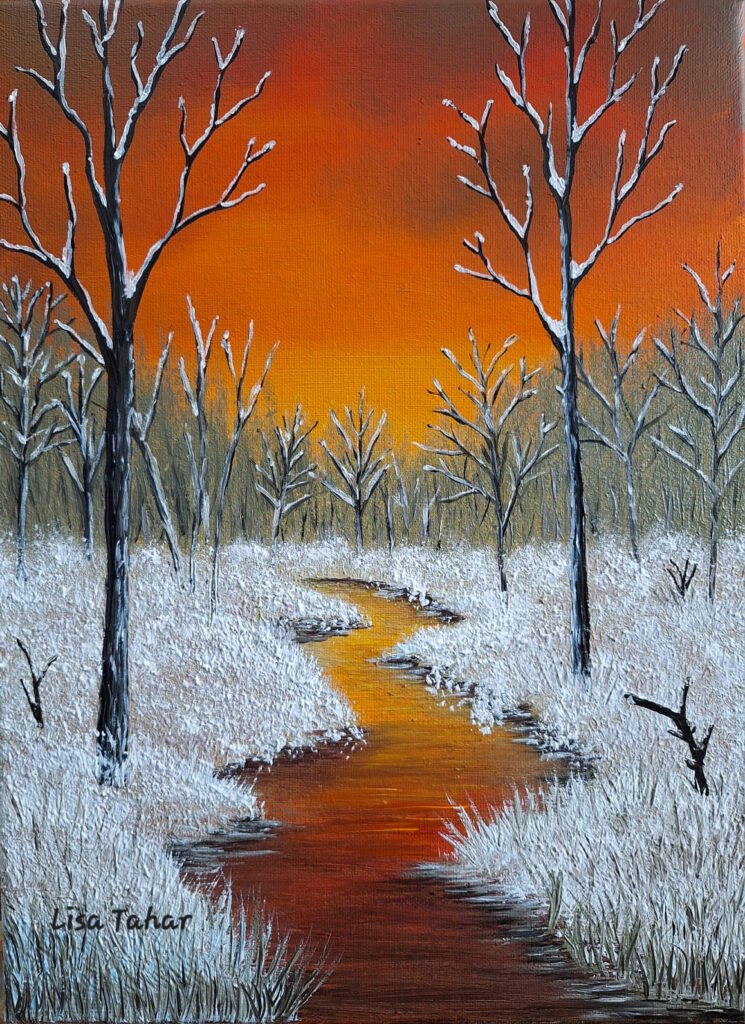
Tahar, however, assigns the work a further meaning. In her reading it is a portrayal of Germany. The colours black, red and gold, those of the national flag, are incorporated into the palette, while the river symbolises what she characterises as a state-orchestrated division of the German people. She situates this within a set of contemporary concerns that she names: mass migration, the question of whether Russia is friend or foe, the energy transition and climate change.
These views are the artist’s own and should be understood as such. Art-historically, the gesture is legible within a long German tradition in which landscape serves as a vehicle for reflection on national identity, from the Romantic period to later reinterpretations of the genre. That Tahar reaches for this tradition through a seemingly modest river scene underlines a recurring truth: the quietest compositions often carry the most pressure beneath the surface.
Exhibition History
Tahar’s public career has developed rapidly. Her first exhibition took place at Gallery Onil, Bremen, in August 2021, followed by a duo exhibition (16-29 April 2022) and further presentations in July/August and November/December of that year.
From 2023 her work has been presented under the curatorial direction of Mauro Giampieri and Prof. Marianna Jurcova of the Art and Culture Center VERUM. This phase includes exhibitions at the Scuola Grande, Venice (September 2023); Galeria La Pigna, Rome (April 2024); the Museum of Art Milan (November 2025); Castle Bratislava (December 2025); Palazzo Bellini, Florence (March 2026); Castle Golling, Austria (May-June 2026); and Galerie Mona Lisa, Paris (July 2026), with a return to the Scuola Grande, Venice, in September 2026.
Alongside the VERUM programme, Tahar has exhibited with ROSSOCINABRO Gallery, Rome (March/April 2025); NARTWORK APS at Gallery Spazio57, Naples (June 2025); Gallerey One One, Prague (April 2026); and ITSLIQUID Group at the Venice International Art Fair (April 2026). This breadth, spanning commercial galleries, institutional venues, historic castles and an international fair, indicates a sustained and varied reception across Italy, Central Europe and France.
Assessment
Tahar’s achievement lies in the coherence of a practice built from limited means. Her compositions rely on a consistent set of elements: river, light, vegetation and a pair of ducks. They are arranged to produce an atmosphere of undisturbed calm. The occasional turn toward overt meaning, as in Winter Evening, does not disrupt this coherence but extends it, showing that the same visual language can bear both consolation and commentary.
Conclusion
That an artist who began painting in 2018 should within a few years command an international exhibition record is notable in itself. More significant is the clarity of her artistic position: a commitment to stillness, to unpeopled nature, and to the landscape as a space where private feeling and public concern can coexist. Lisa Tahar’s work invites the viewer to pause, and, in doing so, to consider what the pause is made of.
Discover Lisa Tahar’s complete catalog of original oil paintings, review her international exhibition itinerary across Europe, or contact curatorial representatives regarding institutional acquisitions and gallery showings.
- 🌐 View the Official Catalog: lisatahar.de
- 📸 Follow International Exhibitions on Instagram: @lisa.tahar