

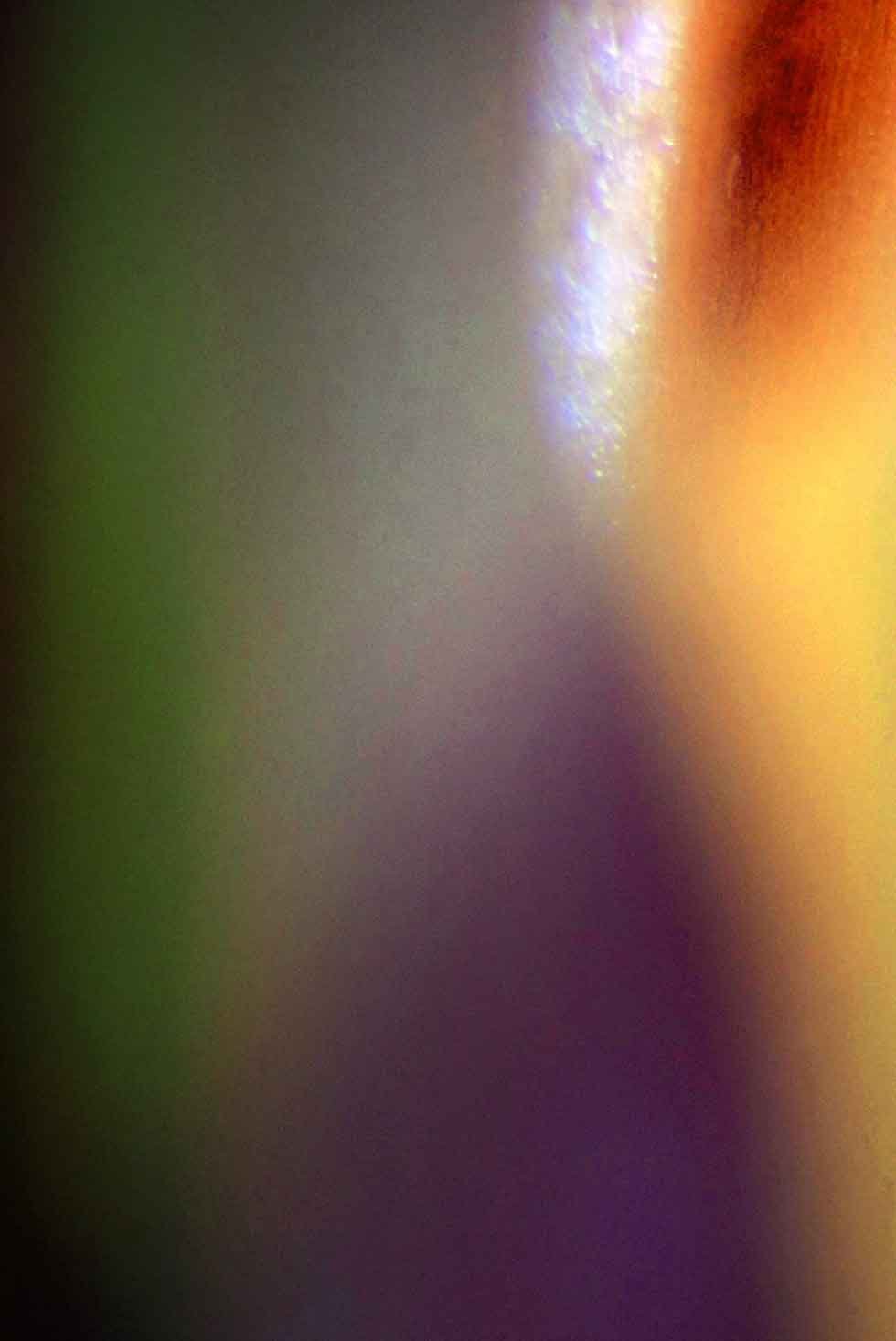
Gradients are easy to make and hard to believe. On a screen, a smooth slide from one hue to another is a few clicks away, and it usually looks exactly like that. Karel Fehr’s Soft Flowing Colours makes a gradient that feels earned, because it is found in a plant. The colour runs down a tall, narrow frame and never once announces itself as a trick.
Colour in Transit
The picture is vertical, almost a strip. On the left, an olive and moss green sits quiet and slightly dark. Moving right, the green thins into a pale, hazy grey, and then, near the upper right, the image catches fire: a bright orange and gold band with a sliver of white at its brightest edge. Below, the warmth cools into purple and pink, pooling toward the base.
The official description names the transition as green to pink, and the picture goes a little further, passing through grey, gold and violet on the way. What matters is the sense of travel. Colour here is not a state but a passage, and the eye moves along it as though following a current. Nothing stops the movement. There are no hard outlines, no objects to break the flow.
The gradient also works as structure. In many abstract pictures, composition comes from shapes. Here it comes from the order of the colours, which divide the frame into zones without any dividing line. The cool green anchors the left, the bright band energises the right, and the purple-pink at the base supplies weight. Remove any one of them and the balance would tip.
A Surface That Works Like a Canvas
According to the official text, delicate surface details, accentuated by subtle illumination, add depth and dimension and turn the botanical subject into a living canvas. The phrase is a useful one, because it describes how the image differs from a simple colour study. A flat gradient has no body. This one has skin.
You can see it in the way the light sits on the surface. The bright edge is softened by a fine bloom, and the colours show slight variations, small shifts in density and tone that suggest a real membrane, thin and slightly translucent. It is the opposite of a digital swatch. The colour has a grain, a temperature and a weight, and that is what keeps the picture from feeling empty.
The macro scale helps too. Because the frame is filled with only a sliver of the subject, scale disappears. We cannot tell whether we are looking at an inch of leaf or a mile of horizon. The result is an image that behaves like a landscape, a painting and a plant at once.
Nature as a Test Bed
It would be easy to describe Karel Fehr as a nature photographer, but pictures like this suggest a slightly different relationship. Nature is not simply what he photographs. It is where he experiments. A leaf edge becomes a laboratory for colour, a petal becomes a lesson in light, a drop of water becomes a lens. The subject supplies the conditions, and the picture is the result of the test.
His official biography describes more than four decades in commercial photography, followed by a turn toward photographic art upon retirement, where he has worked with abstraction and conceptual ideas. In a commercial context, colour is something you control and reproduce faithfully. In his art, colour is something you discover and follow. Soft Flowing Colours reads like the work of a photographer who has stopped asking what the colour should be, and started asking what it wants to do.
The gallery text describes the wider collection in similar terms, noting colours that run from saturated to nearly translucent pastel, chosen for feeling as well as impact. Here the pastel end is on show, though with enough heat in the gold band to keep the picture from slackening into sweetness.
Where Colour Meets Sound
The artist’s homepage adds an interesting dimension. The musician Chris Hinze states there that three of his compositions incorporate Fehr’s images. The documented collaboration is modest and should be described as such. But a picture like Soft Flowing Colours makes the connection easy to imagine, because its gradient behaves like a held note, a long, even slide from one tone to another.
That musical quality is worth keeping in mind as a way of looking. The picture asks for attention to its flow more than analysis of its parts. It rewards the viewer who lets their eye move from top to bottom, then back again, noticing how a green ends and a purple begins without ever finding the line between them.
The finest thing about the image may be that it makes nature feel unfinished, still in motion, still deciding what colour to become. It is a quiet argument for looking at organic surfaces not as fixed subjects but as places where something is always passing through.
Discover the rest of the collection at karelfehr.com.