

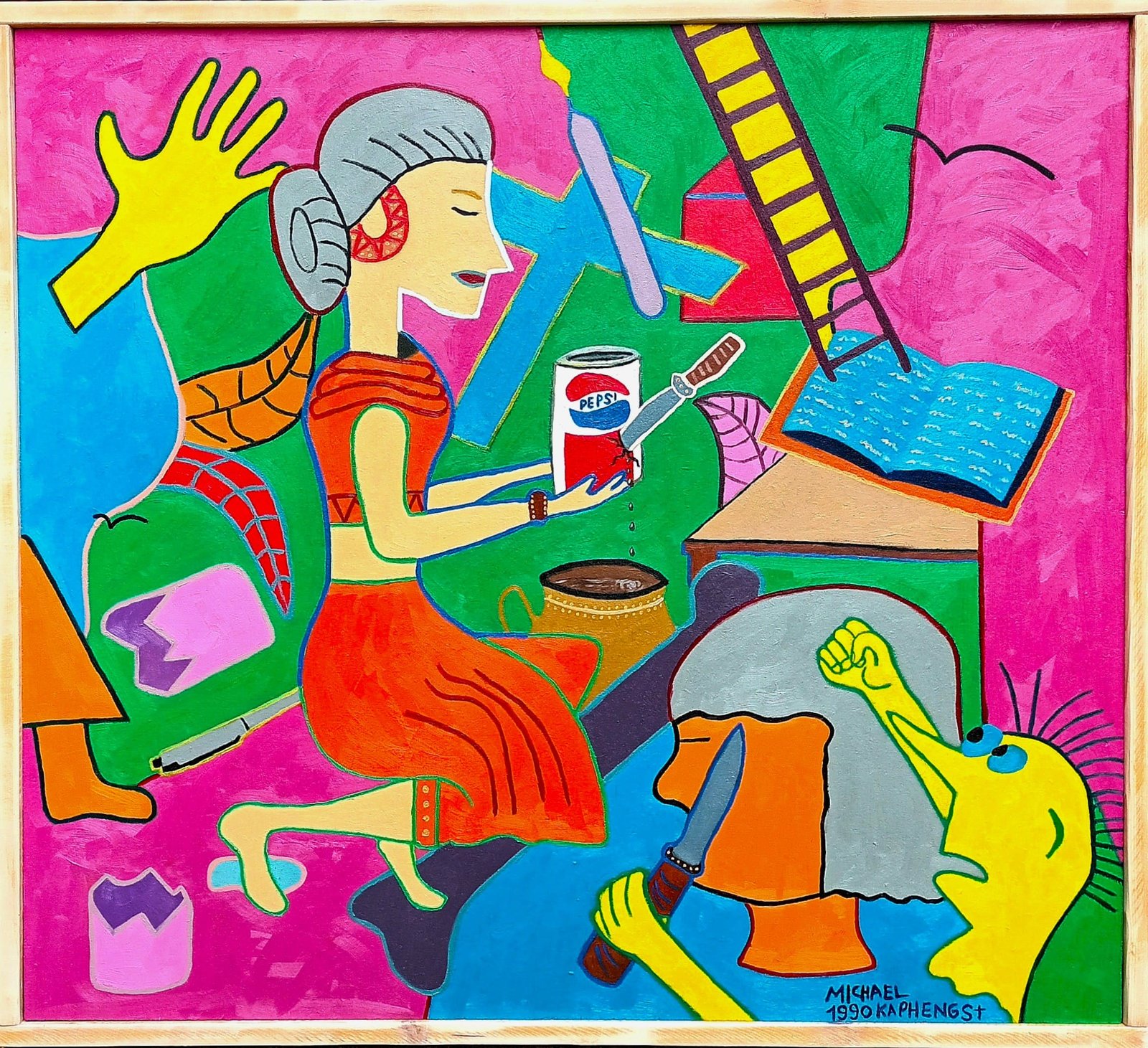
Most painters begin with a subject and let the line serve it. Michael Kaphengst, who calls himself “The Linearist,” reverses the order. “I see the line as the primary force,” he says, “with the image emerging almost as a consequence.” That inversion drives his whole practice and gives it a coherence that is rare in contemporary painting. For Kaphengst, the line is the origin of the work, and the picture is what remains once the line has finished its business.
Process as Subject
Kaphengst’s central idea is that life is a linear process, and that no one can step outside it. Whether we are at work or at leisure, each of us moves through tasks in a sequence that is unique to us, and these sequences shape what we experience. He applies this to the consumer world as well. He does not read consumer culture as “pop,” with its gloss and irony. To him it is another linear process, a continuous stream of goods and routines that accompanies us from childhood onward.
This view changes how he paints. If we are all subject to processes, then the routines and activities that structure daily life are a legitimate source of inspiration, and the painter’s task is to recognize that structure and work with it. Kaphengst treats awareness of process as a tool for finding new approaches, and this keeps his work exploratory.
Three Languages of the Line
He has developed linearism into three distinct modes, each with its own logic.
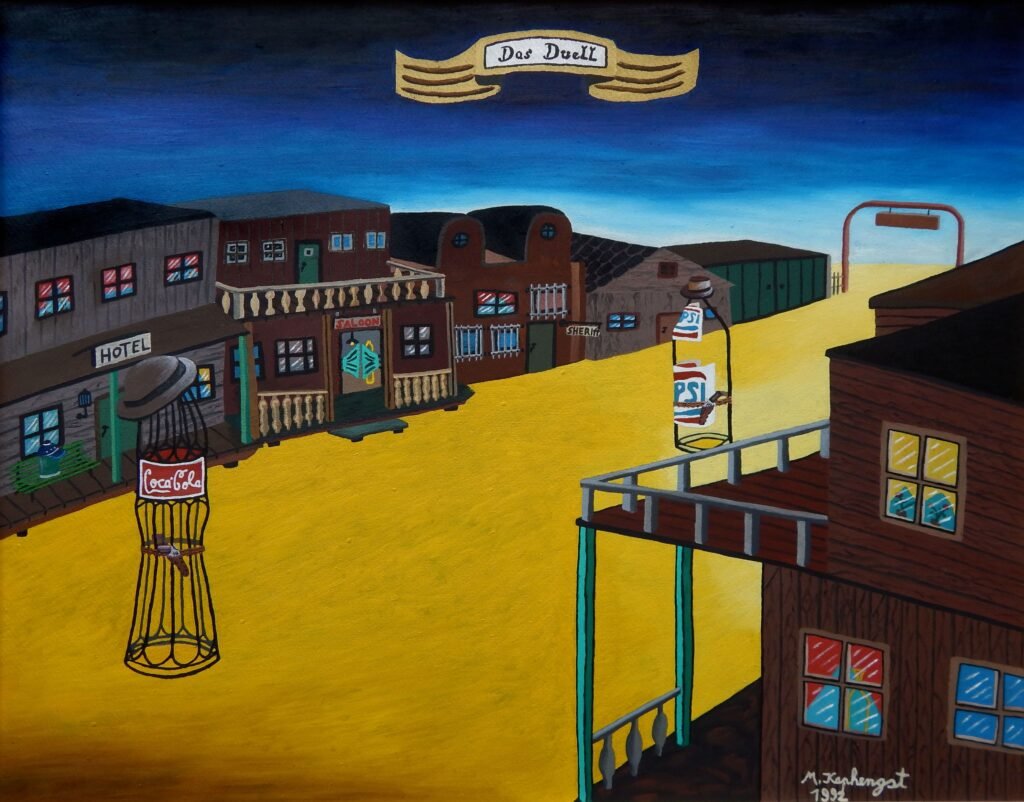
Consumptive surrealism meets the sensory overload of consumer goods with linear form. Everyday objects are pulled out of their ordinary context and take on new artistic meaning. Surreal images emerge because these goods already exert a deep influence on us, and the paintings make visible how often they lead us into strange situations.
Fencing paintings, or “absolute linearism,” rest on a technique Kaphengst developed in 2009. He attaches a brush to the tip of a rapier and draws with it. The method borrows the discipline of the fencer, whose line must be precise and deliberate.
Extreme linearism emerged around 2012, when he began experimenting with uncontrolled circular lines on drawing paper. The pen moves in loose circular gestures that gradually condense into a motif until a single image forms, and that image carries a moving dynamism. Kaphengst calls this the most “extreme” form of his linearism.
The Haptics of Work
The difference between absolute and extreme linearism is, in his words, a haptic one, and he explains it through his earlier working life. As a tile setter, he worked calmly and with intense concentration, in a job that demanded “absolute” focus. As a bartender, he had to move quickly with little time to think, in a job that was “extremely” demanding.
These two jobs became the vocabulary of his two linear methods. His art is built from lived physical experience, and his categories come from real jobs and real bodily states.
An Education Outside the Academy
Kaphengst traces his creativity to childhood. After returning home from a children’s home, he spent hours building cars, ships and houses from Lego bricks. His mother, who suffered from severe manic depression, was also a passionate musician. She played Mozart, Beethoven, Bach and Vivaldi from memory, and for her, he recalls, music was a way to escape everyday reality. She also accompanied the church choir on the organ when its members rehearsed at the family home. Kaphengst played with his bricks nearby, absorbing the sight of someone completely given over to her instrument.
He does not claim “natural talent.” What drives him, he says, is motivation, inner impulse and the pleasure of making. He also suspects that an art academy would only have led to arguments with the professors. He makes no claim about which path is better, but he is clear that his own produced something entirely his own, something “quintessentially ‘Kaphengst.’” For him, that authenticity is worth more than a degree, because only life itself can bestow it.
Academic Recognition
The academy he avoided has still taken notice. The International Academy for Meaning in Poetry and Contemporary Art in Rome awarded him a certificate with a critique of his work DOWN. The critique describes linearism as a process of deconstructing and reconstructing the norms of consciousness. It argues that the work moves beyond the blindness of habitual seeing, the habits that shape perspective, cognitive rules and even prejudice. It speaks of a “Copernican shift” that inverts sunrise into twilight, and of a paradoxical dimension that unsettles the viewer’s ethical framework and opens a new understanding of things.
Early Works
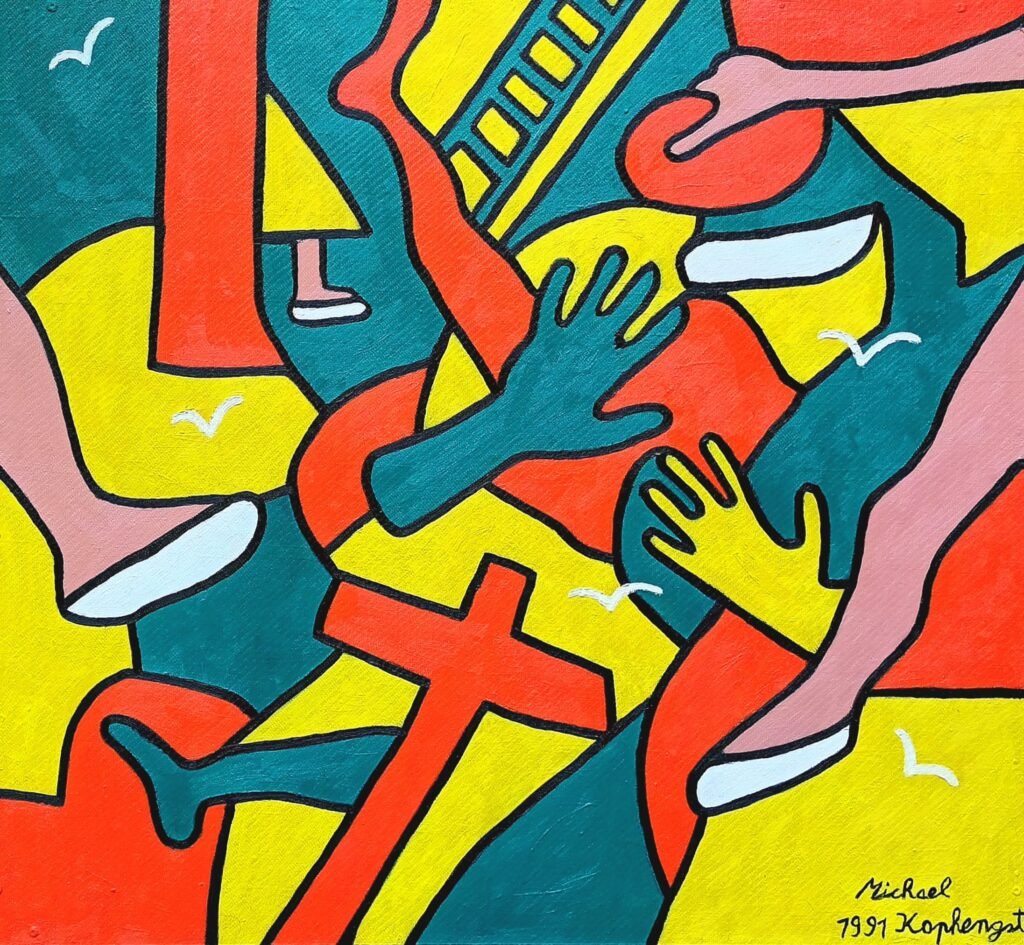
His catalogue reaches back to the early 1990s with titles such as Assassination (1990), Dancer (1991) and Duel (1992). Names like these suggest an early interest in tension, movement and confrontation, themes that sit comfortably alongside the later fencing paintings.
Conclusion
Kaphengst says, “I can’t paint beautiful pictures, only interesting ones.” The line suggests that he is not chasing decoration. His work asks us to notice the processes we live inside, and to see how a single line, followed far enough, can become an image.
Explore the world of Linearism in real time:
Follow Michael Kaphengst’s latest works, studio process, and exhibitions on Instagram: