

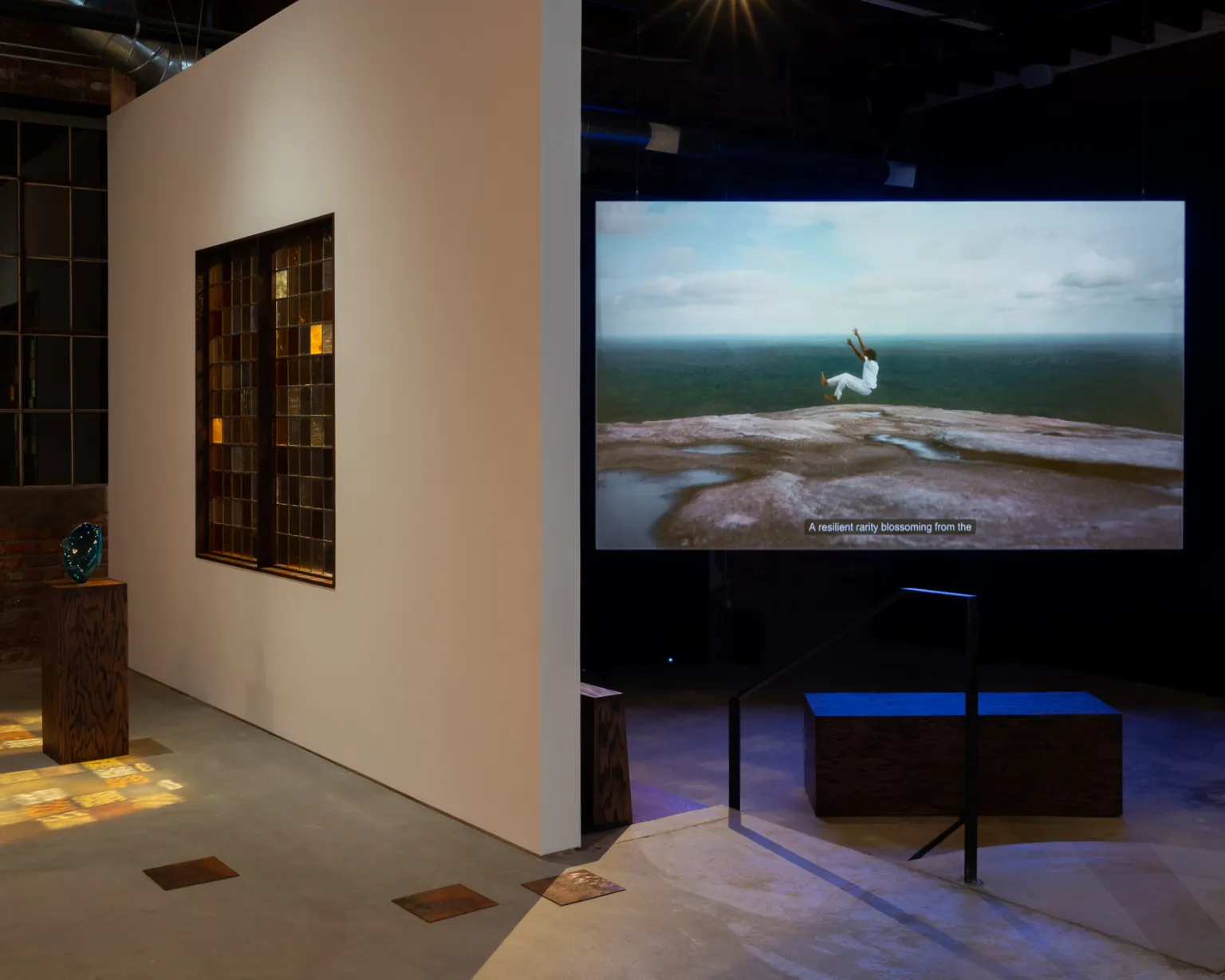
How do you want to die? My response to this question, posed during a death workshop organized by Le’Andra LeSeur in conjunction with her recent exhibition, was startling: lying in a windowed room, surrounded by family, with no regrets. This vision showed me not only what I want at the end, but what I’d like more of now. Thinking about dying is thinking about living, the artist said.
The idea that confronting death can lead to a more meaningful present grounds “Monument Eternal,” an exhibition that ignites from the outset with an invocation of jazz musician Alice Coltrane’s 1977 autobiography from which LeSeur took the title for her show about spiritual and corporeal perseverance. The song “Nobody Knows the Troubles I’ve Seen” (covered by Pastor T. L. Barrett and the Youth for Christ Choir in 1971) reverberates through the warmly lit gallery. This spiritual introduces the show’s namesake and tour de force: a looped, seven-minute video projected in a sunken area at the center of the installation. A percussive call and response score of drums with spoken word poetry by the artist (one memorable line: “My Black mother birthed me into the blues”) syncopates a slow motion shot of a body (LeSeur’s) clad in white as she falls backward in space to meet a smooth expanse of granite. Cut to a shot of a massive carved rock featuring Confederates on horseback, and we understand that this is Stone Mountain, outside Atlanta a three-acre monument to institutionalized racism, carved between 1923 and 1972, which now exists as a public park. In 1915, Stone Mountain was the site of a major Klan revival. Today, it looms over children at play; LeSeur remembers it from her own youth.
The video’s meditation on Black death and resilience charges a number of abstract sculptures nearby. One of these, A soft place to land . . . , 2024, comprises two sets of mouth-blown amber stained glass windows, each set accompanied by a blown-glass vessel (Do you know this place since your breath is no longer here, 2024) that casts orange and blue shadows across the floor. The mottled, handworked surfaces recall the casements of a church, an instrument of colonial oppression but also a space of solace and community. Nearby hang two large gestural paintings, their horizontal surfaces stained and slashed with oil paint, watercolor, gouache, and hibiscus flowers. A faint touch of bones remembering, 2023, is particularly affecting, its rust-colored scratches and cerulean expanses indexing the intensely physical experience of revisiting sites of historical trauma.
A group of new works commissioned in 2025 by the Tulsa Artist Fellowship use industrial steel famously employed by artists such as Donald Judd and Richard Serra to create Minimalist abstractions toward more embodied ends. The series, comprising metal flattened into plates, rolled into bars, and even worked into vases, memorializes Laura Nelson and her son L. D., who were lynched by a racist mob from a steel bridge in Okemah, Oklahoma, in 1911. Their bodies were photographed. Sensitive to the fact that patinas index time and place, the artist treated each object with a gelatin silver emulsion, both recalling and undoing the original photographic violence through a sort of double negative. Several of the oxidized-steel artworks hang on the walls, but even more affecting are the dozens installed directly on the floor: a maze of rusting metal tiles to navigate. Along with a black flag overhead, this floor-bound grouping is collectively titled with the bridge’s coordinates (35°25’46″N96°24’28″W). Subjecting steel to photographic processes and making monuments to people history would rather not remember, LeSeur works against forces of great resistance. Without re-presenting violence, the results are a meditation on death that hopes to inspire the living.