

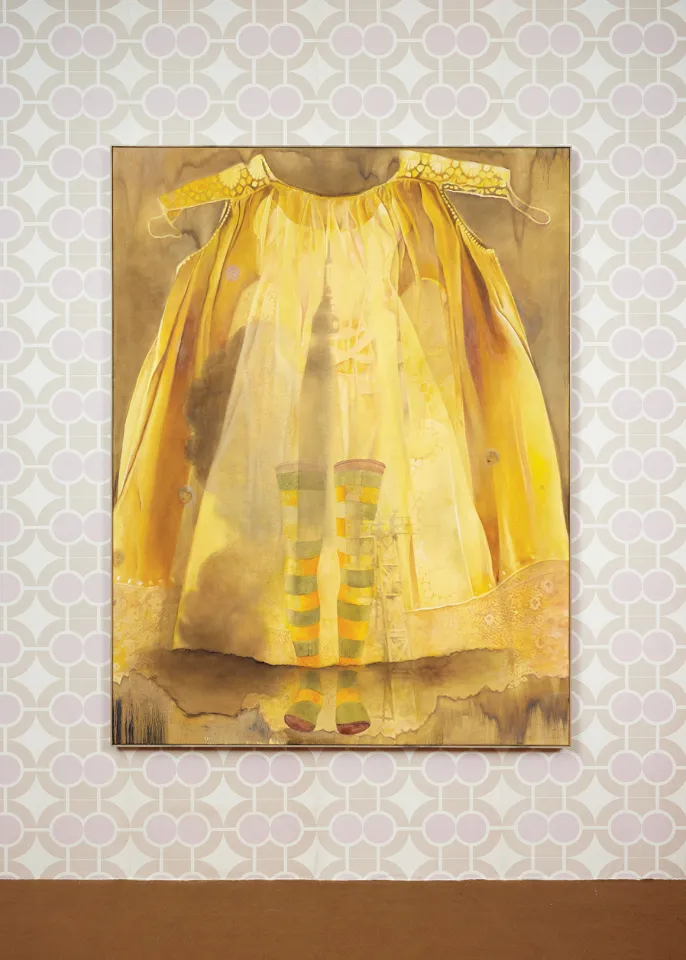
Alexandra Metcalf, silent forms of interspecies panic, 2024, oil and decoupage on linen, 66 7⁄8 × 51 1⁄8″.
“Every father wants a pink dress and bows on their little girls,” said a young female punk rocker sitting in the audience during a mid 1980s episode of Phil Donahue’s talk show. The subject for discussion was outrageous youth fashion. Up on stage sat Serena Dank, founding member of support group Parents of Punkers, who during that decade became a spokesperson for all of the parents horrified by their children’s anarchic taste in fashion and music.
I sought out this grainy recording on YouTube shortly after catching Alexandra Metcalf’s recent exhibition “1st Edition.” The gallery had been turned into a theatrical installation, highlighting Metcalf’s interests and obsessions “the history of madness,” “cycles of womanhood,” “the teenager’s bedroom as the site of the beginning of some rebellious girlhood” which she had outlined in various press interviews surrounding the show. This was a domestic setting hovering in a timeless limbo: the childhood home you return to for the holidays or for a funeral. (Metcalf has described “an overall subdued sadness in the space.”) An aged spiral staircase slithered down from a makeshift hole in the ceiling (My Mind Is Maya, all works 2024). Think Brothers Grimm or a Victorian ghost story. The steps were littered with buttons that, on closer inspection, turned out to be embedded into the wood. Were these a witch’s lure, or had they erupted from the stairs like a bout of teenage acne? The installation’s vintage ’70s wallpaper served up nostalgia for what Tom Wolfe dubbed “the ‘Me’ Decade,” which promised sexual revolution and women’s liberation. But if one stuck around, this room started to give off an ominous vibe; the wallpaper had an uncanny resemblance to the carpets that line the hotel corridors in Stanley Kubrick’s The Shining (1980) another environment that riffs on paranoia, insanity, and the supernatural.
Dank is depicted in a painting called P.O.P., the smallest work in the show. Her image appears as a page clipped from a book or magazine, captions included, and is surrounded by a dark, inky void. She is the scornful mother’s eye, the figure you’re confronted with when stumbling in drunk from a party. Metcalf’s larger paintings are loaded with dreamlike imagery and have an eerie, filmic quality to them. A piece called silent forms of interspecies panic features one of Harry Gordon’s famous ’60s poster dresses (whose packaging also provided the show’s title), as well as hazy images of legs encased in stockings and a rocket launching like newsreel footage mixed with Super 8 home movies. You needed to look again to catch what you missed the first time in this case, the little blotches dotted around the painting, which revealed themselves to be mini portraits of Maria Callas. They are Metcalf’s own version of temporary tattoos, the type a kid will plaster onto their skin before they’re allowed to ink themselves for real. Callas, her mouth open wide in mid-aria, takes on a wholly different appearance when cropped out of her original context. She could just as easily be in a state of orgasm or shrieking in horror. Maybe she’s seen what’s at the top of that staircase.
There was much to decode in this exhibition; its strength with all the works taken together as an ensemble was its evocation of a protagonist who had long since vacated this space, perhaps escaped, leaving us to sift through what was left behind. Who knows what that character was getting up to, but I’ll wager that it was messy and fun and that Serena Dank would strongly disapprove.