

On a plane in 1967, singer Joni Mitchell read a passage from Saul Bellow’s novel Henderson the Rain King in which Henderson, also on a plane, looks out the window and marvels at how, having looked up at the clouds as a child, he had now “dreamed at the clouds from both sides as no other generation of men has done.” Mitchell followed suit, dreaming down at the clouds, studying the scene through the porthole with renewed attention. On that flight, she began writing “Both Sides Now”: “I’ve looked at clouds from both sides now From up and down and still somehow It’s cloud illusions I recall I really don’t know clouds at all.”
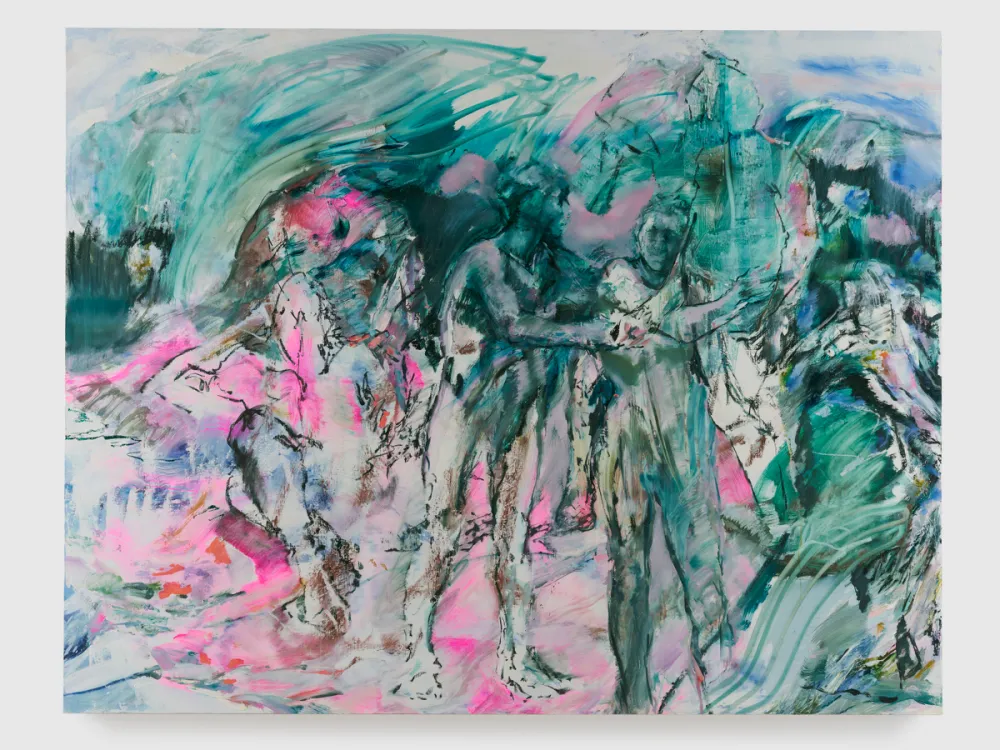
Kylie Manning’s first solo show at Pace in Los Angeles borrows its title from Mitchell’s iconic song. The painter thinks a lot about weather, temperature, and light for instance, the palette of Hinterland (2022) was informed by the cold pink twilight of an Alaskan June, a time and place she knows well, having lived in Juneau for much of her life but those references are opaque to the viewer, as so much is in Manning’s cryptic tableaux.
But the connection to clouds, through Manning’s interest in climate, is not the most important link between these paintings and Mitchell’s tune. Both, crucially, attempt to capture life’s ambiguity and variability: Like cumulus clouds, humans are complex, contradictory, and elusive. Yet too often the characters that populate the works of figurative painters lose their multidimensionality in the translation into paint. They’re viewed from one side only. What sets Manning apart from so many is her ability to convey the human form without pinning it down to a single mood, motive, or meaning a skill that links her to forebears like Édouard Vuillard, Pierre Bonnard, and Willem de Kooning. “Both Sides Now” showcases her series of large scale paintings that nearly dissolve into pure abstraction, but never fully lose their footing in the figurative.

Manning’s work evokes the speed and lightness of a sketch, for the marks feel at first chaotic, almost arbitrary and unfinished, but the longer you look, the more clear it becomes that each mark has been worked over meticulously. The mess of strokes achieves a delicate equilibrium: for example, the light washes of orange in the upper region and lower right corner of You Were Always on My Mind (2022) balance out the heavier tangle of lines and splotches. Manning uses every tool at her disposal brush, palette knife, roller, fingers, etc. and in the hints and hushes of her beautifully strange forms, figures emerge like shapes in clouds. Their bodies are ambiguous; their identities, even more so. Few have a clear gender, sexuality, race, or age. In fact, even her most detailed figures somehow manage to wiggle out of any specificity. One may initially seem like a woman because of how the lips are rendered or the way the neck tilts, but as you continue to look, you notice other markers perhaps a defined jawline or a set of broad shoulders that seem to point in opposing directions. Manning undermines the very idea of so called gender markers (and markers of other “identity groupings”) not just by mixing-and-matching body parts from various sources, but by crafting figures who refuse facile definition.
What they lack in specificity, though, they make up for in potentiality and implication. Scenes build for the viewer in a hallucinatory fashion. In Hinterland, for instance, an eye looking askance jumps out, and a face emerges from the brown and yellow marks hovering around it. This figure’s arm extends down to a gnarled fist, next to which the head of a second figure emerges, this one lying beneath the first, supine. But what is the relation between the first and second figures? Is their interaction one of tender repose, altruistic assistance, sexual seduction, or violent combat? And why do so many other figures, now emerging from behind the original figure, gather round? Is one, perhaps, running for help? The ghostly figures, and the atomized phantasmagoria they inhabit, suggest a memory or dream, with everything somehow both eerily still and in Muybridge motion.

Because of the uncertainty of their identities, and the mystery of their relations, the people who populate Manning’s paintings take on a queer sensibility, grouping the artist with a movement I’ve elsewhere described as the New Queer Intimists, including Doron Langberg, Salman Toor, and Louis Fratino. But she’s not depicting LGBTQ+ narratives explicitly in the same way Langberg (her onetime studio mate) does, where two gay men might lounge on a sofa, bodies intertwined, blurring into the patterns of the furniture. Manning pushes the deterioration of limbs and locations much further. Her gestural abstraction and bold color choices offer atmosphere more than narrative, such that the “narratives” of her paintings are as elusive as mist (easy to imagine, but impossible to grasp). And her figures are “queer” not only in the sense that they are not explicitly cis and straight, but also “queer” in the conventional meaning of the word: they move beyond simple categorization.
Manning looks at life from both sides now, which seems to yield an understanding that, like Mitchell, she “really [doesn’t] know life at all,” so that the best way to capture it is through a set of ambiguous illusions. This allowance or, more precisely, this courting of mystery, uncertainty, and doubt is what makes her visions in oil on linen as enticing, as evocative, as compelling as reality.