

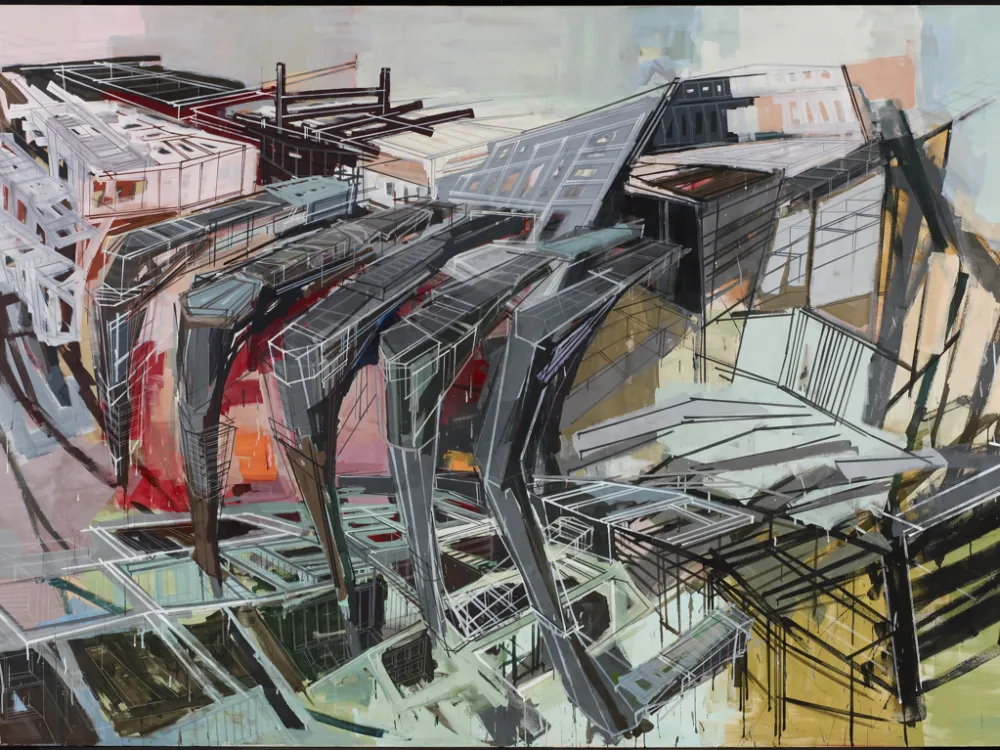
Too often, a retrospective comes too late. Such is the case with “Just Beyond,” a survey of works by late Trinidadian Canadian painter Denyse Thomasos at the Art Gallery of Ontario. Carefully pieced together, the exhibition of acrylics on canvas, works on paper, and archival materials (personal photographs, sketchbooks) follows the artist from her student work and early ventures in allegorical figuration to her murals and later bold formalist abstractions.
While the career-wide selections of “Just Beyond” do illuminate key stylistic developments, Thomasos’s subjects particularly the architecture of cages, boats, and scaffolding flow through these classifications. Throughout her career, Thomasos revisited in paint the places she traveled, attempting to make sense of how Indigenous sites and domestic structures around the world Dogon caves, Jodhpuri rooftops, and boats on the Yangtze River might serve as reminders of resistance and resiliency, even in the face of structural oppression. These works that her journeys inspired also speak to Thomasos’s feelings of alienation and dislocation as part of the Caribbean diaspora in Canada (and later as a Canadian national in the United States) and her family’s struggle to adapt. Seeking other modes of shelter and survival was a personal as much as an artistic necessity. In her own words, “With every line, every mark, it’s a language that I weave together to survive.”
One epic mural on view here, Arc (2009), amalgamates Thomasos’s signature motifs. A rib cage of lines curves over the 20 foot wide composition, which otherwise features stacks of forms like the elements of a cityscape under which small boats jut out; skulls yawn and roll across and off the canvas. The work draws from earlier pieces such as Sacrifice (1989), an allegorical painting about slave prisons in West Africa that depicts a black horse hanging from the ceiling in a sling above a pile of human skulls.
Although Thomasos is clearly interested in built forms, her work is conceptually invested in the act of unbuilding, as seen throughout the 1998 series “Dismantle.” These compositions feature dark, restrained coloration, and zero in on cuboid structures that recall prison architecture. By their titles, the paintings call for taking apart the systems of confinement that the artist shows to be omnipresent. The largest of the series, at six feet square, is Dismantle #1, which features a field of loose, perspectival cages in multiple colors, dominated by black, brown, and white, that evoke housing complexes. Long drips of paint and intentional lines intersect, replicating seemingly ad infinitum, like units in massive residences and the dense populations they contain.

The exhibition’s final room shows how Thomasos shifted from specific to broader structural allusions in some of her largest works. Dos Amigos (Slave Boat), 1993 named after a 19th-century ship that transported enslaved Africans to Cuba is placed next to Virtual Incarceration (1999). The former marks Thomasos’s shift from figuration to abstraction; assertive black and white lines comprise a tight, gridded closeup of a boat extending off the canvas, washing over the viewer. In the latter, by contrast, insidious lines trail into the white background, visualizing systemic confinement in what more closely resembles a digital rendering.

The grids and lines throughout these paintings are not solely tied to modernism in an art historical sense: they address modernist systems of urban planning, social control, and segregation. Thomasos also melds this motif of formalist abstraction with history painting through deeply personal and political gestures. Undergrids are exposed, parallel lines expressively drip, and subjects reveal their skeletal selves in all these works, where building and body are inextricable; while figures do not appear in most of Thomasos’s paintings, their absence is overwhelmingly felt and understood as extinguished by the structures that remain, which must ultimately fall.
It is in Thomasos’s last works, from 2012, that her allover markings are most unyielding, seemingly zoomed in for emphasis. Big blocks and broad stripes of solid color bubblegum pink, chartreuse, mauve—fill the canvases and stand out brightly, their grids now less prominent but their composition no less constrained. We can only imagine what might have come after these works, given Thomasos’s death in 2012, at age 47. All in all, she left us with a haunting formal synthesis of the harsh and violent realities of enslavement.