

One November night in 1974, a boisterous crowd spilled out onto 57th Street in Manhattan as a new gallery opened in what was then the center of the art establishment and its elite power brokers. Linda Goode Bryant, a 25-year-old single mother fueled by a vision and some debt, opened the space to support an emerging group of Black conceptual artists whose work strayed from the representational mode celebrated in Harlem the city’s Black art Mecca while going unrecognized by New York’s white art world. At the gallery known as Just Above Midtown, they found a home.
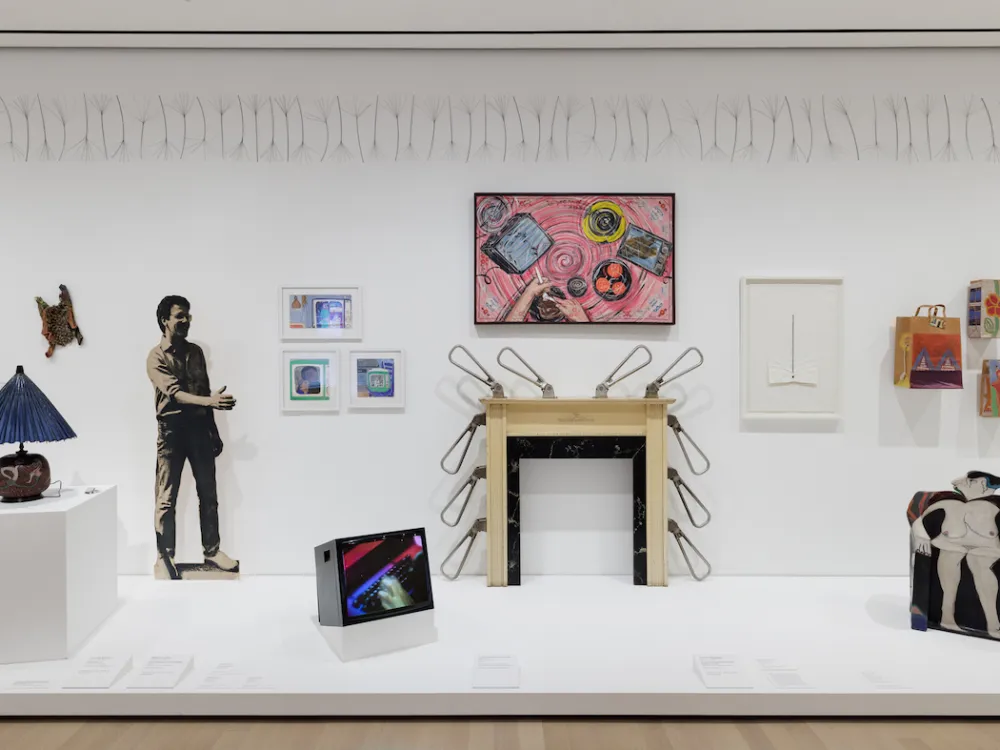
The gallery is now the subject of an exhibition at the Museum of Modern Art, curated by Thomas (T.) Jean Lax in collaboration with Goode Bryant, that gathers more than 120 works of art and ephemera from JAM’s 12 feverish years of existence. In that period, the gallery moved three times, mostly due to evictions but the exhibition demonstrates that, despite its structural precarity, JAM offered resistant space for artists to play at the edges of the art world’s established mores.
One of the first works on display is Wendy Ward’s Untitled (Three Inches Equals One Week of Laundry),a sculpture from around 1974 in which differently hued clumps of lint are compressed in a sterile Plexiglas box material evidence of oft invisible labor and a rehabilitation of detritus into aesthetic wonder. Nearby is a work by Randy Williams featuring the 1971 art historical text L’Art Abstrait and a Malevechian black square fastened to unfinished wooden shiplap Modernist symbols superimposed onto Black southern vernacular architecture. At once riotous and discreet, these works introduce a profound interest in everyday material and playful social critique.

Works by now celebrated JAM regulars such as David Hammons, Senga Nengudi, Lorraine O’Grady, and Howardena Pindell hang alongside works by those less familiar to the mainstream art press. Susan Fitzsimmons’s Hang Ups: Hair (1979) preserves the artist’s own brown tresses in clear Lucite. Jorge Luis Rodriguez’s 1978/2022 Circulo con cuatro esquinas (Circle With Four Corners) an elegant readymade of a metal hoop recovered from a dumpster leans in the corner. It’s the presentation of these latter works that brings new and illuminating context for the former, such as Hammons’s virtuosic experiments with barber-shop hair and grease, or Nengudi’s distorted, anthropomorphic pantyhose. The better known works are recast as part of an impressive artistic constellation, and art history’s affinity for individuation is undone in favor of collective thought.
In a room that explores the gallery’s Tribeca years, works mingle like eclectic friends: an anthropomorphized earthenware chair by Camille Billops, decorated lunch bags by Seneca artist G. Peter Jemison, vibratory metalwork by Maren Hassinger, a diorama by Janet O. Henry, and a lightbox displaying hundreds of slides submitted for review to the gallery, each pulsing with future potential. So much in such proximity could threaten to overwhelm the senses, but the impression instead is a sense that JAM found energy in its radical embrace of difference.

With a tendency toward organic materials and an emphasis on process over product, much of the predominantly abstract work on display might sit comfortably under the term postminimalist but Goode Bryant had another name: “Contexturalist.” “The artists of this movement,” Goode Bryant wrote with art historian Marcy S. Phillips in 1978, “after determining and clarifying the inherent properties of art, go outside its margin in order to incorporate it within the context of external phenomena.” An excerpt of this text is reproduced digitally in the exhibition, evidence of Bryant’s early wisdom transforming the art world required not only the display and sale of work by artists of color, but a totally new language for emergent forms. It feels like no coincidence, then, that JAM’s third iteration in Soho would also provide the breeding ground for a new arts criticism: Broadsheets from B Culture, a Black arts periodical published by JAM and edited by the late Greg Tate and Craig Dennis Street, line a wall in the show.
One corridor displays eviction notices and overdue debts that beleaguered the space, casting the gallery in contrast to its former neighbor and current host: the moneyed, geographically stable, and slow to-transform MoMA. JAM was a space committed always to evolution so much so that it calls into question the use of the past tense. The exhibition adopts JAM’s founding spirit, extending beyond MoMA’s walls and throughout New York during its run with artist commissions in Brownsville, Williamsburg, the East Village, and a performance festival worthy of its own review. Fifty years later, JAM still doesn’t play by the rules. JAM lives.